

If your SEO reports only tell you what is happening on Google, you may be missing part of the picture.
Bing has its own search results, ranking systems, audience, and performance patterns. A page that performs well on Google can occupy a very different position on Bing. That makes search-engine-specific tracking useful when Bing visibility matters to your business.
A Bing rank tracker monitors where your pages appear for selected keywords in Bing Search and records those positions over time. The useful part is not simply knowing that a page is “ranking.” It is understanding which keywords are moving, which URLs are gaining visibility, which competitors are appearing above you, and whether your SEO work is producing measurable progress.
Bing Webmaster Tools remains an important source of first-party information. Its Search Performance report provides data such as impressions, clicks and average click-through rate for verified websites.
But dedicated rank-tracking software can answer a different question: Where does my page rank for this keyword, in this market, on this device, compared with competing pages?
That distinction matters.
What Is a Bing Rank Tracker?
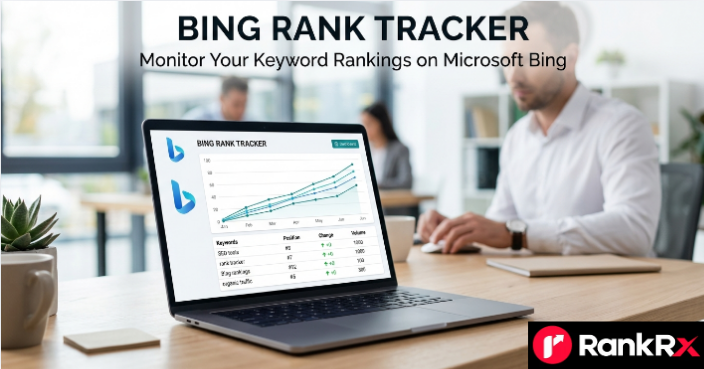
A Bing rank tracker is an SEO tool that monitors the position of a website or webpage in Bing’s organic search results for specific keywords.
Instead of checking Bing manually every morning, you enter the keywords that matter to your business and let the tracking system collect ranking data on a schedule.
Depending on the platform, you may be able to monitor:
- Keyword positions
- Ranking URLs
- Position changes
- Competitor rankings
- Desktop and mobile results
- Country or regional rankings
- SERP features
- Historical ranking data
- Ranking alerts
- Search visibility
- SEO reports
The exact features vary considerably between tools, so it is important to check what a platform actually measures before buying it.
This is especially important because search results are not static. Location, language, device, search history, competition and changes to search-result layouts can all affect what users see.
Why Track Bing Rankings When Google Gets More Attention?
Google remains central to most SEO campaigns, but optimizing for one search engine does not automatically tell you how your site performs everywhere else.
Bing uses its own search systems. Consequently, your Google position should not be treated as a proxy for your Bing position.
For example, imagine an online software company ranking:
| Keyword | Bing | |
|---|---|---|
| cybersecurity software | 8 | 19 |
| endpoint security platform | 11 | 7 |
| security monitoring software | 14 | 10 |
Looking only at Google would hide the opportunity.
The Bing data could reveal that one page is already performing relatively well for a commercially valuable query. Instead of rebuilding the entire strategy, the SEO team might investigate why that page performs better on Bing and whether its content can be strengthened.
READ MORE: What Is Rank Tracking A Practical Guide for Site Owners in 2026
That is the real value of rank tracking: better decisions, not prettier dashboards.
Bing Webmaster Tools vs. Dedicated Rank Tracking
One of the most important distinctions is between Bing’s own webmaster platform and third-party ranking tools.
Bing Webmaster Tools is free and should be part of the basic SEO toolkit for websites that care about Bing. Bing says its platform provides Search Performance information and additional SEO tools for verified sites.
A dedicated tracker serves a different purpose.
| Capability | Bing Webmaster Tools | Dedicated Rank Tracker |
| Bing search performance | Yes | Usually |
| Verified-site data | Yes | Depends on tool |
| Exact tracked keyword positions | Limited | Usually |
| Competitor monitoring | Limited | Common |
| Historical keyword tracking | Yes, but different from rank logs | Usually |
| Location tracking | Tool-dependent | Often available |
| Device segmentation | Depends on report | Common |
| Ranking alerts | Limited | Common |
| Client reporting | Limited | Common |
| Multi-engine tracking | Not the primary purpose | Common |
This does not mean you should choose one and ignore the other.
A better workflow is often to use Bing Webmaster Tools for first-party search performance and indexing information, while using a rank-tracking platform for controlled keyword monitoring and competitive analysis.
Bing’s current Webmaster Tools also includes recommendations based on SEO best practices for verified sites, making it useful for identifying technical and discoverability issues.
7 Smart Ways to Use Bing Rank Tracking
Tracking positions is easy.
Using the information intelligently is harder.
Here are seven practical ways to turn ranking data into better SEO decisions.
1. Build a Focused Keyword Set
Do not start by tracking every keyword you can find.
Choose terms that represent genuine business opportunities.
For a software company, the list might include:
- Product-category keywords
- Problem-based searches
- Commercial queries
- Comparison terms
- Brand searches
- Local searches
- Long-tail questions
- High-value industry terms
A useful keyword set should represent different stages of the customer journey.
For example:
Informational:
“how endpoint security works”
Commercial investigation:
“best endpoint security software”
Transactional:
“endpoint security platform”
Branded:
“[brand] endpoint security”
Tracking all four types gives you a more useful picture than monitoring 100 variations of the same phrase.
2. Track the URL, Not Just the Keyword
A ranking number without the ranking URL can be misleading.
Suppose your site ranks for “network security software,” but Bing is showing an old blog post rather than your main product page.
Technically, you have visibility.
Strategically, you may have a problem.
Check which URL is ranking for important terms and ask:
- Is this the page I want users to find?
- Does the page match search intent?
- Is the title accurate?
- Does the content answer the query completely?
- Should another page be the primary destination?
- Are multiple pages competing for the same topic?
This type of analysis can uncover cannibalization and content-architecture problems that a simple average ranking number cannot show.
3. Compare Bing and Google Carefully
Comparing search engines can reveal useful differences, but do not assume one algorithm is simply “better.”
If a keyword ranks #5 on Bing and #24 on Google, investigate the pages rather than immediately changing everything.
Look at:
- Search intent
- Content depth
- Page structure
- Internal links
- Backlinks
- Relevance
- Search-result features
- Competitor pages
- Technical accessibility
The goal is not to copy Google’s results onto Bing.
The goal is to understand why the two search environments produce different outcomes.
4. Watch Competitor Movement
Competitor tracking is one of the strongest reasons to use a dedicated platform.
Suppose your ranking has remained at position 12 for three months.
That sounds stable.
READ MORE: What’s Trending in the UK Right Now And How to Actually Use That Information
But then you discover that three competitors have moved from positions 20–30 into the top 10.
Now the situation looks different.
Your position did not fall, but your competitive environment changed.
Monitor competitors for:
- New ranking pages
- New content
- Position gains
- Position losses
- Newly targeted topics
- SERP feature appearances
- Backlink growth
- Content updates
Ranking data becomes much more useful when you interpret it comparatively.
5. Separate Local, National and International Visibility
Search visibility can vary significantly by location.
A business targeting the UK should not assume that a ranking observed from another country represents what UK searchers see.
The same applies to international companies.
A keyword might perform strongly in:
- The United Kingdom
- The United States
- Canada
- Australia
while performing differently elsewhere.
If local SEO matters to your business, track the markets that actually generate customers.
For a local company, that could mean monitoring target cities or regions where the tracking platform supports that level of geographic precision.
For an international company, country and language segmentation can reveal opportunities that an aggregated ranking report hides.
6. Monitor Ranking Changes After Major SEO Work
Rank tracking becomes especially valuable when connected to real changes on your website.
For example:
Week 1: Rewrite an underperforming landing page.
Week 2: Improve internal links.
Week 3: Add original supporting content.
Week 4: Review rankings and organic traffic.
Do not assume that any movement was caused by one change. Search rankings are influenced by many variables, and correlation does not prove causation.
Instead, treat ranking data as evidence that helps you investigate what happened.
This is particularly important after broad search updates.
Google’s May 2026 core update ran from May 21 through June 2, 2026, according to Google’s Search Status Dashboard. Google described core updates as changes intended to better surface relevant and satisfying content.
The lesson for SEO teams is simple: do not react emotionally to a short-term ranking fluctuation. Look for patterns, compare affected pages, examine search intent and review the quality of the content before making major changes.
7. Turn Ranking Data Into Content Decisions
A ranking report should lead to action.
If a page sits at position 11 for a valuable keyword, that can be more interesting than a page already ranking #1.
Why?
Because moving from the second page into the first page may represent a meaningful opportunity, although no ranking improvement is guaranteed.
Review the page for:
- Missing information
- Weak explanations
- Poor search-intent alignment
- Outdated examples
- Weak internal linking
- Unclear headings
- Poor user experience
- Lack of original insight
- Better competitor coverage
Then make a focused improvement rather than rewriting everything blindly.
What Features Should You Look for?
Not every ranking tool is built the same way.
Before choosing one, consider these features.
Accurate Bing Data
The most important question is where the ranking data comes from.
You want actual Bing results rather than a number inferred from another search engine.
Several current tools specifically advertise Bing SERP monitoring, with features such as location targeting, device tracking and historical positions.
Location and Device Tracking
If your audience is geographically diverse, location controls matter.
Likewise, desktop and mobile visibility may differ.
Look for the ability to select:
- Country
- Region
- City, where supported
- Language
- Desktop
- Mobile
Do not pay extra for geographic precision you will never use, though.
Historical Data
One ranking snapshot is not very informative.
READ MORE: Best Netflix Shows UK August 2026 What’s Actually Worth Your Time
A trend is.
Historical data can help you identify:
- Gradual growth
- Sudden losses
- Recovery
- Seasonal changes
- Competitor gains
- Algorithm-related volatility
- Effects of major content changes
The longer you track a meaningful keyword set, the more useful these comparisons can become.
Competitor Tracking
A competitor report should tell you more than who ranks above you.
Ideally, it helps answer:
Which competitors are improving, for which topics, and with which pages?
That turns rank tracking into competitive research.
Alerts
You do not need to check your dashboard constantly.
Alerts can notify you about significant ranking changes so that your team can investigate when something important happens.
Avoid setting alerts for every tiny movement. Search results fluctuate.
Instead, establish sensible thresholds around meaningful events, such as:
- Entering the top 10
- Leaving the top 10
- A major position drop
- A major position gain
- A competitor entering an important SERP
Reporting
Agencies and larger teams often need scheduled reports.
But a good report should explain performance, not simply dump numbers into a PDF.
A useful SEO report might include:
- Visibility trend
- Priority keyword changes
- Ranking URLs
- Major wins
- Major losses
- Competitor movement
- Recommended actions
The report should help someone decide what to do next.
Free vs. Paid Bing Rank Tracking
You do not necessarily need expensive software.
For a small website with a limited number of keywords, Bing Webmaster Tools may provide enough first-party data to understand basic performance.
A paid platform becomes more attractive when you need structured keyword monitoring.
| Website type | Sensible approach |
| Small personal site | Bing Webmaster Tools + occasional checks |
| Small business | Webmaster Tools + focused rank tracking |
| E-commerce site | Daily/regular keyword and competitor monitoring |
| SEO agency | Multi-client tracking and reporting |
| Enterprise | Large-scale tracking, segmentation and integrations |
The best tool is not necessarily the one with the longest feature list.
It is the one that provides the data you actually need at a reasonable cost.
How to Set Up a Practical Tracking System
You can keep the process simple.
Step 1: Verify the Website
Start with Bing Webmaster Tools.
Bing provides several verification methods and allows verified sites to access its webmaster reports and tools.
Step 2: Submit Your Sitemap
Make sure Bing can discover the important URLs on your website.
Bing’s getting-started documentation specifically recommends adding XML sitemaps or other supported sitemap formats. bing rank tracker.
Step 3: Choose Priority Keywords
Start with perhaps 20–50 commercially or strategically important terms rather than hundreds of low-value phrases.
Group them by:
- Topic
- Intent
- Product
- Location
- Funnel stage
Step 4: Select Your Markets
Choose the countries, regions or cities relevant to your audience.
Do not mix unrelated markets into one average.
Step 5: Record Baseline Rankings
Before making major changes, record the current position and ranking URL.
That gives you a reference point. bing rank tracker.
Step 6: Connect Rankings With Traffic
Ranking position is not the same as business success.
A keyword can rank well but generate little traffic.
Another keyword can rank lower but attract highly qualified visitors.
Whenever possible, compare rankings with: bing rank tracker.
- Impressions
- Clicks
- Organic sessions
- Engagement
- Leads
- Sales
- Conversions
This creates a much stronger SEO measurement system.
Bing Rankings Are Not the Same as Traffic
This is one of the easiest mistakes to make. bing rank tracker.
Suppose a page moves from position 15 to position 8.
That sounds positive. bing rank tracker.
But what if the keyword receives very little search demand?
The ranking improvement may have little commercial value.
Conversely, a small improvement on a high-intent keyword can matter considerably.
Think of rankings as an input metric, not the final business KPI.
A useful measurement chain looks like this: bing rank tracker.
SEO work → rankings → impressions → clicks → engaged visits → conversions
The further you move toward the right side of that chain, the closer you get to business value.
Bing SEO and the AI Search Shift
Search measurement is becoming more complicated because users increasingly encounter answers generated or assisted by AI systems. bing rank tracker.
This does not make traditional SEO irrelevant.
Google’s current guidance says the same foundational SEO practices remain relevant to AI Overviews and AI Mode. Google also says there are no special technical requirements specifically required to appear in those AI experiences beyond being eligible for normal Search. bing rank tracker.
Google’s May 2026 guidance similarly emphasized valuable, unique, non-commodity content rather than special “AI optimization” tricks. bing rank tracker.
Bing is also expanding measurement beyond conventional rankings. Its AI Performance report can show how site content is cited in AI-generated answers across supported Microsoft experiences, including Copilot and AI-generated summaries in Bing. Bing explicitly notes that this report measures citation activity rather than conventional ranking authority or performance. bing rank tracker.
That distinction is important.
Ranking visibility and AI citation visibility are related, but they are not the same metric.
A modern SEO measurement strategy may eventually need both.
How to Interpret a Sudden Ranking Drop
Do not immediately delete the page or start building hundreds of backlinks.
First, investigate. bing rank tracker.
Check whether the drop is isolated
If one keyword falls but your other rankings remain stable, the issue may be query-specific.
If hundreds of keywords decline at once, investigate broader causes. bing rank tracker.
Check the ranking URL
Did Bing switch from one page to another?
Did an important page disappear from the results?
Check indexing
Make sure the page remains accessible and indexable.
Check technical changes
Review recent changes involving:
- Canonical tags
- Robots directives
- Redirects
- Internal links
- Site migrations
- Templates
- Server errors
- Page availability
Check competitors
Perhaps your site did not get worse.
Perhaps competitors got better.
Check the SERP
Search the keyword and examine the current results.
Are users being shown:
- Different content types?
- More product results?
- Local results?
- Videos?
- Forums?
- Fresh news?
- AI-generated answers?
Search intent can evolve. bing rank tracker.
Your page may still be well written but no longer be the strongest answer for the query.
Common Mistakes to Avoid
Tracking Too Many Keywords
More keywords do not automatically produce better insights.
Track terms connected to real strategic decisions.
Obsessing Over Daily Movement
A one-position change is rarely a crisis.
Look for meaningful trends. bing rank tracker.
Ignoring Ranking URLs
Knowing the position without knowing the page can hide content-architecture problems.
Using Google Data as a Bing Substitute
Different search engines can produce different outcomes.
Measure the engine you actually care about.
Treating Rankings as Revenue
A position is not a sale. bing rank tracker.
Connect SEO data to conversions wherever possible.
Buying a Tool for Features You Will Never Use
Some platforms offer enormous datasets and complex dashboards.
If your business only needs 50 keywords across two countries, a simpler solution may be better.
Changing Everything After One Ranking Drop
Search results fluctuate. bing rank tracker.
Investigate before reacting.
READ MORE: RankRX The Modern Framework for Data-Driven SEO Success
A Better Bing SEO Workflow for Small Teams
Small teams do not need a complicated enterprise system.
A practical monthly workflow could look like this:
Week 1 — Review rankings
Identify meaningful gains and losses.
Week 2 — Review pages
Inspect the URLs behind major changes.
Week 3 — Improve content
Strengthen pages with realistic opportunities.
Week 4 — Measure business impact
Compare organic traffic, leads and conversions.
Then repeat. bing rank tracker.
This approach keeps SEO connected to actual business decisions instead of turning it into a daily ranking-watching exercise.
Is Bing Rank Tracking Worth It?
For many websites, yes — but the answer depends on how important Bing is to the audience.
If nearly all your customers come from Google and your Bing traffic is negligible, basic Bing Webmaster Tools data may be enough. bin.g rank tracker
If Bing already generates meaningful traffic, you operate in markets where Bing has stronger adoption, or you manage SEO for clients, dedicated tracking becomes more useful.
The key is to avoid buying a tool simply because “Bing SEO” sounds like another box to tick.
Use it when the data can change what you do.
Conclusion
Bing should not be treated as a smaller copy of Google.
It is a separate search environment with its own results and its own opportunities. For businesses that receive meaningful Bing traffic, operate internationally, target Microsoft-heavy audiences or want a more complete view of organic visibility, monitoring those results can make SEO decisions more precise. bing rank tracker.
The smartest approach is not to chase ranking numbers for their own sake.
Use Bing Webmaster Tools for first-party performance and site information. Use dedicated tracking when you need controlled keyword positions, competitor comparisons, geographic segmentation or historical trends. Then connect those measurements to traffic, leads and revenue. bing rank tracker.
SEO remains probabilistic. No tracker can guarantee higher rankings, and no single ranking position can explain the entire performance of a website. Results vary by site, industry, search intent, competition and changes in search systems. bing rank tracker.
The best measurement system is therefore the one that helps you understand what changed — and, more importantly, what you should do next. bing rank tracker.
FAQs
What is a Bing rank tracker?
A Bing rank tracker monitors where your website’s pages appear for selected keywords in Bing search results. Depending on the platform, it can also track competitors, locations, devices, historical changes and SERP features.
Can I check Bing rankings for free?
Yes. Bing Webmaster Tools provides first-party search performance information for verified websites. Free and paid third-party tools can provide additional keyword-position monitoring and competitive features.
Why are my Google and Bing rankings different?
Google and Bing use different search systems, so the same page can rank differently on each platform. Differences in relevance, content, links, search intent, location and other signals can contribute to different results.
How often should I check Bing rankings?
For most small websites, weekly or several-times-per-month review is enough. Larger websites, agencies and businesses running active SEO campaigns may benefit from daily tracking. The important thing is to focus on trends rather than reacting to every small fluctuation.
Should I use Bing Webmaster Tools and a rank tracker together?
Often, yes. Bing Webmaster Tools provides first-party information about your verified website, while a dedicated tracker can provide controlled keyword monitoring, competitor comparisons and historical position data. They solve different measurement problems.
Does ranking on Bing help with AI search visibility?
Traditional Bing rankings and AI citation visibility are not identical. Bing now provides an AI Performance report that shows how pages are cited in supported AI-generated experiences.
For more updates visit: rankrx.co.uk