
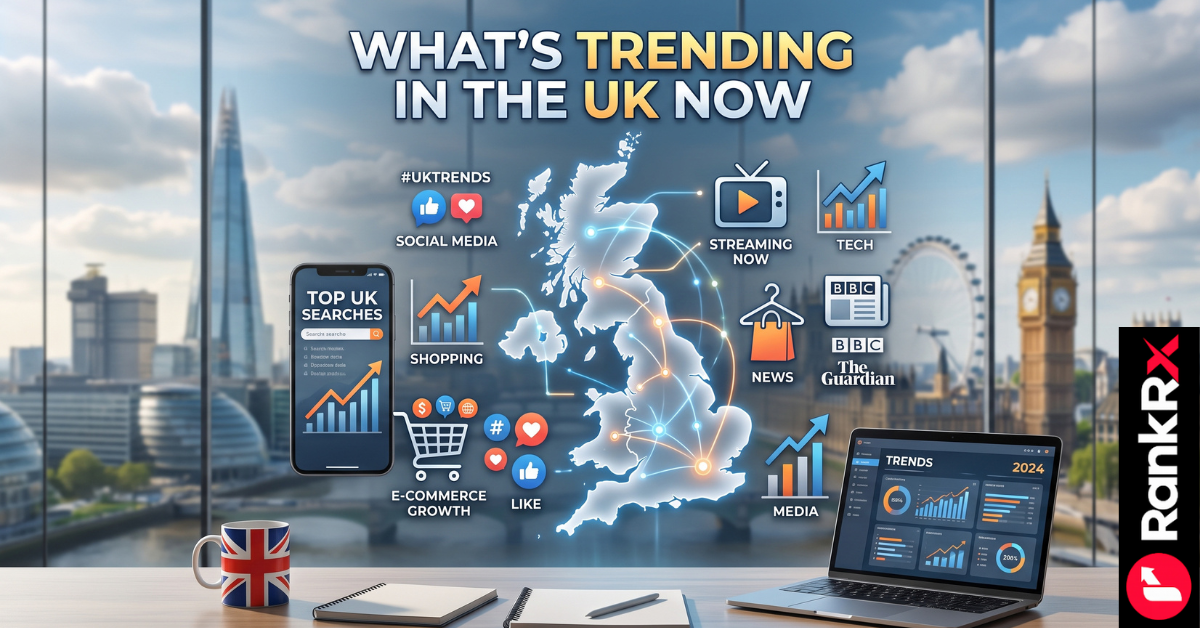

Type “what’s trending in the UK right now” into Google and you’ll get a mess of results: a Twitter/X trends widget frozen at whatever moment it was scraped, a TikTok discover page full of dance challenges, and a couple of “Year in Search” reports that are already months out of date. None of it tells you what’s actually useful to know if you’re a marketer, a content creator, or just a curious reader trying to keep up.
So let’s separate the two very different things people mean by “trending”:
- Right-now trending — the hashtags, news stories, and viral clips spiking in the last few hours. This changes by the minute and no article, including this one, can capture it live.
- Directional trending — the bigger shifts in what Brits are watching, buying, searching for, and talking about over weeks and months. This is far more useful for planning content, campaigns, or just understanding the national mood.
This guide covers both, plus the actual tools you can use to check live UK trends yourself, because a snapshot in an article is stale the moment it’s published.
Why “Trending” Is Two Different Questions
Before diving into specifics, it helps to know that “trending” gets used loosely. A topic can trend on X (formerly Twitter) because of a spike in volume over a normal hour that’s often news, sport, or a TV moment. A topic can trend on TikTok because the algorithm is pushing a sound or format regardless of whether anyone outside the app has heard of it. And a topic can trend on Google Search because millions of people are quietly typing the same question, with none of the noise of social platforms. what’s trending in the UK right now.
These three signals often don’t overlap. A TV storyline can dominate TikTok for a week without ever showing up in Google’s trending searches. A policy change can spike on Google Search while barely registering on social media. If you’re trying to understand “what’s trending in the UK right now” for content or marketing purposes, mixing these up is one of the most common mistakes more on that later.
The UK Trend Categories Worth Watching
Rather than chase every viral moment, it’s more useful to track the categories where UK trends actually shift consumer and reader behaviour. Here’s what’s been shaping the conversation recently, and why each one matters.
1. News and Current Affairs
Breaking news — royal family stories, sport results, and major political or economic developments — consistently drives the fastest spikes in UK search and social volume. These trends are short-lived by nature: a football score or a court case update might dominate for a day and vanish by the weekend. If your content strategy depends on news-jacking, speed matters more than depth, but accuracy matters even more — publishing something wrong in the rush to be first does lasting damage to trust. what’s trending in the UK right now.
2. Sport, Especially Major Tournaments
Large sporting events reliably produce some of the biggest search and social spikes of any given year in the UK. Tournament brackets, match results, and player storylines pull huge volume in short, predictable windows. If your site has any tangential connection to sport, travel, hospitality, or retail, planning content around the tournament calendar is one of the more dependable ways to catch a real traffic wave rather than chasing something unpredictable.
3. TikTok and Short-Form Video Culture
TikTok remains a dominant force in shaping what feels “current” in the UK, especially among younger audiences. A few patterns have held steady: what’s trending in the UK right now.
- Nostalgia formats — throwbacks to 2016-era aesthetics, filters, and music have resurfaced strongly, spreading from social media into fashion and design. what’s trending in the UK right now.
- Silent, visual-first storytelling — short clips that rely on facial expression, captions, and everyday relatable moments (queueing, commuting, weather complaints) rather than audio, because they perform well on mute.
- AI-assisted content and duets — creators experimenting with AI voice and video tools to remix existing clips, which is a fast-growing but also fast-changing area with real questions around authenticity and disclosure.
These formats move quickly and burn out just as fast, so treat any specific TikTok trend as a snapshot rather than a strategy. what’s trending in the UK right now.
4. Fashion and Shopping Behaviour
UK fashion trends increasingly start on social commerce platforms rather than runways. A few threads worth knowing:
- Aesthetic-led shopping (buying based on a “vibe” or mood board rather than a brand name) has grown, partly driven by TikTok Shop and similar in-app shopping features. what’s trending in the UK right now.
- Microtrend cycles have compressed from seasons to days, which has reignited debate around fast fashion’s environmental impact — a tension that’s genuinely part of the conversation, not a settled issue.
- ’90s and Y2K-influenced looks, layered textures, and “old money” adjacent styling have had staying power longer than most microtrends. what’s trending in the UK right now.
5. Food and Drink
UK food trends tend to move in two directions at once: comfort and indulgence on one side, and health-conscious choices on the other. Recent shifts include: what’s trending in the UK right now.
- Growing interest in protein, fibre, and “functional” foods alongside more everyday indulgence categories.
- Continued growth in low- and no-alcohol drink options. what’s trending in the UK right now.
- Coffee culture variations (twists on classic drinks) that circulate through UK cafés and then spread on social media. what’s trending in the UK right now.
- Food-to-go remaining resilient even when household budgets are under pressure, because convenience wins out on busy days. what’s trending in the UK right now.
6. AI Tools and Search Behaviour
This is arguably the most significant background shift of the last couple of years, even though it rarely trends as a headline itself: people are asking longer, more conversational questions in search, and AI-powered assistants have become part of everyday search behaviour rather than a novelty. For anyone producing content, this changes what “ranking” even means — being the source an AI answer draws from now matters as much as being the top blue link.
READ MORE: RankRX The Modern Framework for Data-Driven SEO Success
A Quick Comparison: Where Different Trends Show Up
| Trend Type | Typical Lifespan | Best Signal Source | Good For |
|---|---|---|---|
| Breaking news | Hours to a few days | X/Twitter, Google Trends (real-time) | Timely blog posts, social commentary |
| TV and entertainment moments | Days to a couple of weeks | TikTok, Google Trends | Recap content, fan communities |
| Major sporting events | Weeks (with daily spikes) | Google Trends, sports data sites | Retail, hospitality, betting-adjacent content (where compliant) |
| Fashion and lifestyle | Weeks to a season | TikTok, Pinterest, retail data | Ecommerce, style guides |
| Food and drink | Months | Supermarket and hospitality reports, TikTok | Recipe content, product launches |
| Search behaviour shifts (like AI-assisted search) | Ongoing, gradual | Google Search Central, industry reports | Long-term SEO and content strategy |
How to Check Live UK Trends Yourself
Since anything printed in an article ages quickly, here’s where to look for the actual current picture:
- Google Trends — filter by United Kingdom and by “past 4 hours” or “past day” for a real-time view of rising searches.
- X/Twitter trending topics for the UK — useful for news and sport spikes, though the algorithm surfaces volume, not necessarily importance. what’s trending in the UK right now.
- TikTok’s Discover page — set to UK region, for spotting emerging sounds and formats before they go mainstream elsewhere.
- Reputable news aggregators and the BBC/ITV news homepages — for confirming whether a trending topic is a real story or just social noise.
Checking two or three of these together, rather than relying on just one, gives a much more reliable read than any single “top 10 trends” list.
Common Mistakes to Avoid When Chasing UK Trends
- Treating a TikTok trend as a Google Search trend. They’re different audiences with different intent, and content built for one often flops on the other.
- Publishing “trend roundup” content with no new angle. If ten other sites already covered the same trending topic, a genuinely useful take (data, an expert view, a practical how-to) is what earns rankings — a rehashed summary usually doesn’t.
- Chasing every micro-trend. Not every viral moment is worth a content piece. The ones with staying power (a real shift in behaviour, not just a meme) are usually the better investment.
- Ignoring the freshness problem. A “what’s trending” article needs a visible publish or update date and a plan to revisit it, or it quickly becomes misleading.
- Assuming trending equals valuable to your business. A topic can have huge volume and zero relevance to your niche. Relevance to your actual audience should always outweigh raw search volume.
The Upside and the Limits of Trend-Chasing Content
There’s a real upside here: trend-aware content can capture genuine search demand at the moment interest is highest, and it signals to readers (and to Google) that a site is current and paying attention. That’s a fair part of a healthy content strategy.
But it has real limits too. Trend-based traffic tends to be short-lived and doesn’t always convert into loyal readers or customers. Chasing trends too aggressively can also crowd out the kind of in-depth, evergreen content that actually builds long-term authority and trust — the E-E-A-T signals Google has been increasingly focused on. The most resilient approach tends to combine a smaller amount of timely trend coverage with a larger base of genuinely useful, well-researched evergreen content.
As with most things in SEO and content marketing, results vary a lot depending on your niche, your audience, and how competitive your specific market is — there’s no single formula that guarantees traffic from trend content.
READ MORE: Best Netflix Shows UK August 2026 What’s Actually Worth Your Time
Conclusion
“What’s trending in the UK right now” isn’t really one answer — it’s a moving picture made up of news cycles, social platform algorithms, search behaviour, and slower cultural shifts in fashion, food, and lifestyle. The most useful approach isn’t trying to catalogue every viral moment, but understanding which category a trend belongs to, checking a couple of reliable live sources before acting on it, and being honest about how long that relevance is likely to last. Used well, trend-awareness is a genuinely useful layer on top of a solid content strategy — not a replacement for one.
FAQs
Is there one single place to check what’s trending in the UK right now?
Not reliably. Google Trends, X/Twitter, and TikTok each surface different kinds of trends, so checking more than one source gives a far more accurate picture than relying on a single “top trends” list.
How long do UK trends usually last?
It depends heavily on the category. Breaking news trends often fade within a day or two, TikTok formats might run for a few weeks, and slower shifts like changing food or search habits can play out over many months.
Do I need to jump on every trending topic for SEO purposes?
Chasing every trend without relevance to your niche rarely pays off and can dilute a site’s focus. It’s usually better to be selective and add real value when you do cover a trend.
How has AI changed what counts as “trending” in UK search?
People are increasingly asking longer, more conversational questions and getting AI-generated summaries alongside traditional results, which means visibility now depends on being a credible source AI tools pull from, not just ranking in the traditional list of links.
Are TikTok trends and Google Trends the same thing?
TikTok trends reflect what the platform’s algorithm is pushing to a mostly younger audience, while Google Trends reflects actual search volume across a much broader population. A topic can dominate one and barely register on the other.
Where can I find historical UK Google search trend data?
Google Trends itself lets you look back over custom date ranges, and Google’s annual “Year in Search” report is a useful yearly snapshot, though it reflects sustained spikes rather than the single most popular searches overall.
For more updates visit: rankrx.co.uk