
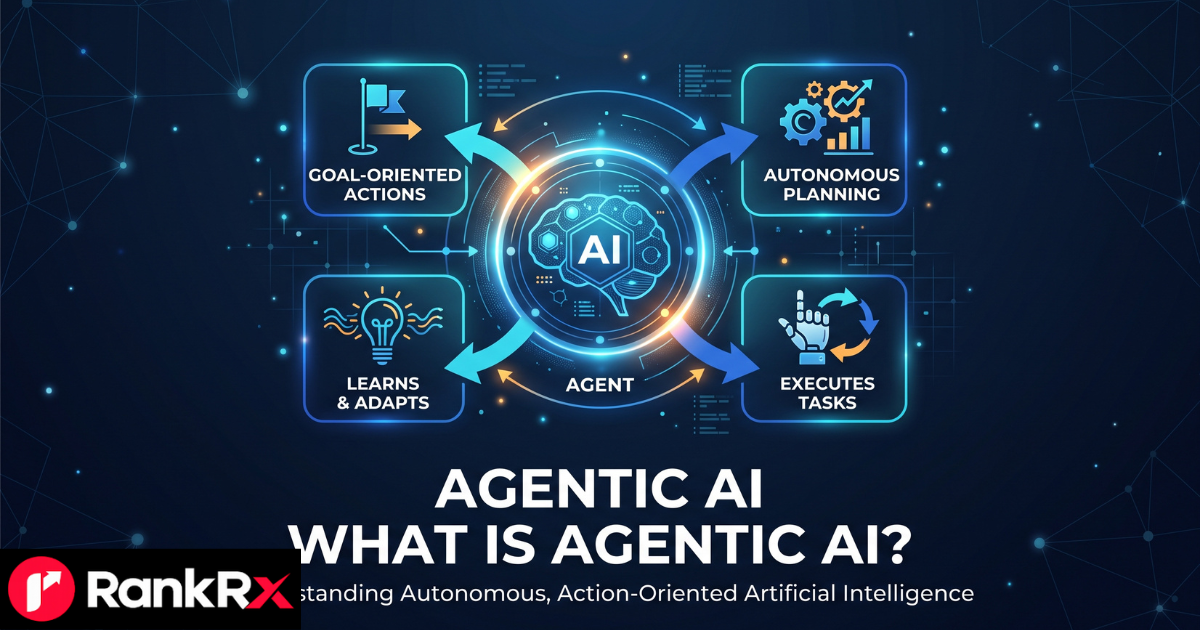

You’ve probably noticed the term “agentic AI” showing up everywhere this year in vendor pitches, LinkedIn posts, and now Google’s own AI Mode announcements. Most explanations either drown you in jargon or oversell it as some kind of digital employee that runs your business while you sleep. Neither is accurate. So let’s break down what agentic AI actually is, how it’s different from the AI tools you’re already using, and why it matters if you run a website, a marketing team, or a small business. agentic ai what is agentic ai.
What Is Agentic AI, Exactly?
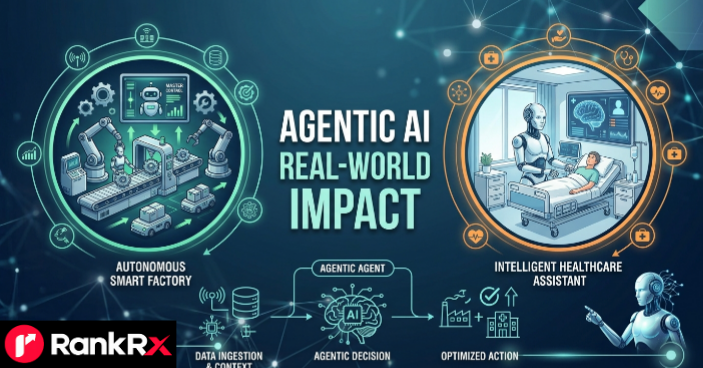
Agentic AI is artificial intelligence that can plan a sequence of steps, use tools to carry them out, and adjust its approach based on what happens without a human approving every single move. That’s the core idea behind agentic ai, and it’s the piece that separates it from a standard chatbot.
Think about the difference this way: a normal AI chatbot answers a question and stops. It waits for your next prompt. An agentic AI system is given a goal instead of a single instruction “research these five competitors and summarise their pricing,” for example and it works through that goal in stages: it searches, reads, extracts data, checks its own output, and only comes back to you with a finished result (or a question, if it gets stuck).
Most researchers and vendors describe this as a loop: the system perceives information, reasons about what to do next, takes an action using a tool, and then learns from the outcome before repeating the cycle. That loop is what lets agentic AI handle multi-step tasks instead of single-shot answers. agentic ai what is agentic ai.
It’s worth being precise here, because the term gets stretched to cover almost anything with “AI” in the name. A tool that just autocompletes text isn’t agentic. A tool that books a meeting, checks your calendar for conflicts, and reschedules if something clashes with minimal supervision is closer to what people mean by agentic ai.
READ MORE: What Is Agentic AI and How It Works (2026 Guide)
Agentic AI vs AI Agents vs Generative AI
This is where a lot of confusion creeps in, so here’s a simple table to keep the terms straight.
| Term | What it means | Example |
|---|---|---|
| Generative AI | Produces content (text, images, code) from a prompt | Writing a blog draft from an outline |
| AI agent | A specific software system built to complete tasks using tools | A bot that files support tickets |
| Agentic AI | The property of acting autonomously toward a goal, across one or more agents | A system that researches, drafts, checks, and publishes a report with limited check-ins |
In practice, “AI agent” is the noun (the actual tool), and “agentic” is closer to an adjective describing how independently that tool can operate. Some tools sit closer to a simple chatbot; others can run several steps unsupervised. It’s a spectrum, not an on/off switch, and most products on the market today sit somewhere in the middle rather than at the fully autonomous end. agentic ai what is agentic ai.
How Agentic AI Actually Works
Strip away the marketing language, and most agentic AI systems are built from a handful of core parts:
- A planning layer that breaks a broad goal into smaller, ordered steps
- Memory (short-term and sometimes long-term) so the system doesn’t lose context halfway through a task
- Tool access — APIs, browsers, databases, or software — that lets it actually do things, not just describe them
- A feedback or self-check step where the system reviews its own output and decides whether to continue, retry, or stop
This combination is why agentic AI can do things a plain generative model can’t: pull live data, cross-check facts against a source, fill in a form, or coordinate several smaller sub-tasks toward one outcome. It’s also why it needs more oversight than a simple content generator — more moving parts means more places for something to go wrong.
Real-World Examples of Agentic AI
To make this concrete, here’s where agentic AI shows up already, often without the label being used at all:
- Customer support, where a system resolves a ticket end-to-end — checking an order database, issuing a refund, and confirming with the customer — only escalating to a human when it hits an edge case.
- Coding assistants that don’t just suggest a line of code but can write a feature, run tests against it, and fix failures before handing it back for review.
- Marketing and SEO workflows, where a tool can pull keyword and competitor data, draft content around it, and flag gaps — though the strategic calls (what to prioritise, what tone fits your brand) still need a human.
- Research assistants that gather sources across the web, compare claims, and produce a structured summary instead of a single answer. agentic ai what is agentic ai.
- Finance and operations, where systems monitor transactions or portfolios and take predefined actions when conditions are met. agentic ai what is agentic ai.
READ MORE: GME Applicant Ranking Software What It Is and How to Choose One
Notice a pattern: in almost every serious deployment, a human still sets the goal, sets the guardrails, and reviews the output at some point. That’s not a limitation of the technology today — it’s how well-run agentic systems are actually being deployed. agentic ai what is agentic ai.
Benefits of Agentic AI
- Fewer manual handoffs. Multi-step tasks that used to bounce between three tools and two people can run as one continuous process. agentic ai what is agentic ai.
- Faster turnaround on repetitive, well-defined work. Research, data pulls, and first-draft content can happen in the background. agentic ai what is agentic ai.
- Better handling of “in-between” tasks — the ones too complex for basic automation but too repetitive to justify a person doing them manually every time. agentic ai what is agentic ai.
- Scalability for teams that are short on hands, particularly small businesses and solo operators who can’t hire for every function. agentic ai what is agentic ai.
Limitations and Risks You Should Know About
This is the part a lot of hype-driven content skips, and it matters for trust as much as it does for your own decision-making. agentic ai what is agentic ai.
- Reliability is still inconsistent. Agentic systems can misinterpret a goal, take an unintended action, or get stuck in a loop, especially on ambiguous instructions. agentic ai what is agentic ai.
- Most projects don’t reach production. Independent industry analysis in 2026 has pointed out that a large share of enterprise agentic AI pilots never make it past the prototype stage — largely due to security review, lack of monitoring, or integration problems, not the underlying AI being incapable. agentic ai what is agentic ai.
- Oversight and audit trails matter. Because these systems take real actions (sending emails, moving money, publishing content), the security and governance side — logging what the system did and why — is now its own field of practice, not an afterthought. agentic ai what is agentic ai.
- Cost and compute. Multi-step reasoning and tool use consume more resources than a single prompt-response exchange, which affects pricing at scale.
- It’s not “set and forget.” Every credible source on this topic agrees that agentic AI still needs defined boundaries, monitoring, and a human checkpoint for anything with real-world consequences.
None of this means agentic AI isn’t useful — it means it’s a tool with a learning curve and real operational requirements, not a magic autopilot.
Common Mistakes to Avoid When Adopting Agentic AI
- Giving it a vague goal. “Improve our marketing” isn’t a task an agentic system can act on. “Pull last month’s top 10 organic pages and flag which ones dropped in ranking” is.
- Skipping the review step. Treating the first output as final, especially for anything customer-facing or published externally.
- No guardrails on tool access. Letting a system take actions (spending, publishing, deleting) without limits or approval thresholds.
- Assuming one tool does everything. Most real workflows still combine an agentic tool with human judgment and other software — it’s rarely a full replacement.
- Ignoring the monitoring side. Not tracking what the system actually did makes it hard to catch mistakes early or explain decisions later.
Agentic AI and Search: Why This Matters for Site Owners
Google’s own AI Mode and AI Overviews are themselves built on agentic principles — breaking a search query into sub-questions, checking multiple sources, and assembling an answer rather than just returning a list of links. Google has stated publicly that AI Mode’s usage has grown sharply through 2026, and that shift changes how content gets discovered. This doesn’t replace traditional SEO, but it does mean structured, clearly sourced, genuinely useful content has a better shot at being cited in AI-generated answers, on top of ranking normally. Google’s own guidance continues to stress the same thing through every recent core update: content quality and genuine expertise matter more than which tool produced the first draft.
READ MORE: RankRX The Modern Framework for Data-Driven SEO Success
Final Thoughts
Agentic AI is a genuine shift in what AI systems can do moving from “generate an answer” to “carry out a goal.” But it’s still an emerging, evolving space, and results depend heavily on how well a business defines the task, sets guardrails, and reviews the output. Treat it as a capable assistant that needs direction and oversight, not a fully autonomous replacement for strategy or judgment.
FAQs
Is agentic AI the same as AI agents?
Not quite. An AI agent is the actual software system. “Agentic” describes how autonomously that system can plan and act. A tool can be a basic agent or a highly agentic one — it’s a spectrum.
Do I need coding skills to use agentic AI tools?
Many agentic AI products are built with no-code interfaces aimed at marketers, support teams, and small business owners. Technical setups exist too, mainly for custom workflows.
Is agentic AI safe to use for a small business?
It can be, with the right setup — clear goals, limited permissions, and a human checking important outputs before they go live. It’s not something to hand full control to without oversight, especially early on.
How is agentic AI different from generative AI like ChatGPT?
Generative AI produces content from a prompt and stops. Agentic AI is given a goal, works through multiple steps using tools, checks its own progress, and keeps going until the task is done or it needs input.
Will agentic AI replace marketing or SEO jobs?
Unlikely in the near term. Current deployments consistently pair agentic tools with human strategy and review — the technology handles repetitive multi-step execution, not judgment calls about brand, tone, or priorities.
What industries use agentic AI the most right now?
Customer support, software development, research, and finance operations show the most mature use cases so far. Marketing and SEO adoption is growing but still tends to be tool-assisted rather than fully autonomous.
For more updates visit: rankrx.co.uk