

You’ve probably typed a question into ChatGPT or Claude and gotten a good answer back. That’s not an AI agent. It’s a chatbot. The difference matters more than most explainers admit, and if you’ve been confused by the flood of “agentic AI” marketing this year, you’re not alone half the tools calling themselves agents in 2026 are really just chatbots with a new label stuck on. what is an ai agent in simple terms.
Let’s clear that up properly.
The Simple Definition
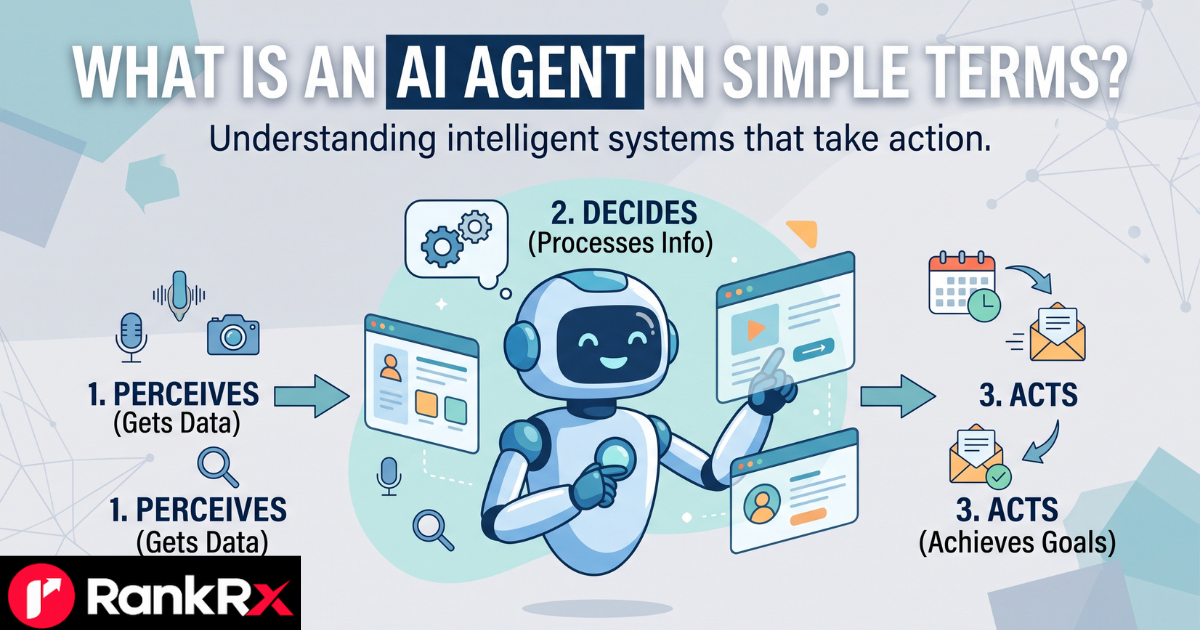
An AI agent is software that can take a goal, figure out the steps needed to reach it, and actually carry out those steps on its own using tools, checking its own results, and adjusting as it goes without you telling it what to do at every stage.
Think of it this way: a chatbot answers your question. An AI agent goes and does the thing.
If you ask a chatbot to “find me the cheapest flight to Manchester next Friday,” it might tell you how to search for one. An agent would actually open a browser, search flight sites, compare prices, and hand you a booking link checking its own work along the way and adjusting if a site doesn’t load or a price changes.
That distinction deciding the next step itself versus waiting for you to supply it is the one thing worth remembering from this entire article. what is an ai agent in simple terms.
Why This Term Is Suddenly Everywhere
Two things happened at once. First, the underlying language models got good enough at reasoning and planning to hold together a multi-step task without falling apart halfway through. Second, standards for connecting AI systems to real tools things like browsers, code editors, calendars, and business software matured enough to make that reasoning actually useful in the real world.
The result is that 2026 has become the year “agent” replaced “AI” as the buzzword of choice. Every software vendor with a chatbot feature has rebranded it. That’s created genuine confusion for site owners, marketers, and small business owners trying to work out what’s real and what’s repackaged. what is an ai agent in simple terms.
It also means search behaviour is shifting. Google has confirmed that AI Mode passed a billion monthly users and is testing autonomous “Search agents” that can carry out multi-step tasks on a searcher’s behalf, rather than just returning a page of links. Search sessions are increasingly turning into back-and-forth exchanges instead of single one-off queries. If you write content in this space, that shift is worth understanding, even if the specifics of how it affects rankings are still settling. what is an ai agent in simple terms.
READ MORE: What Is Agentic AI A Practical Guide for Marketers and Site Owners
The Four Building Blocks of an AI Agent
Most working definitions of an AI agent boil down to the same four components. You don’t need to be technical to follow this — think of it as a simple team structure.
- Perception — the agent takes in information: your instructions, a webpage, a file, or data from an API.
- Reasoning (planning) — it works out what steps are needed to reach the goal, using a large language model as the “brain” behind the decision-making.
- Tool use (action) — it actually does something: runs a search, calls an API, writes code, sends an email, or edits a spreadsheet.
- Memory — it keeps track of what it has already tried, what worked, and what the current state of the task is, so it doesn’t repeat itself or lose the thread. what is an ai agent in simple terms.
Put together, these four pieces create a loop: the agent perceives, plans, acts, observes the result, and plans again. That loop keeps running until the goal is met or the agent decides it needs to check in with a human.
AI Agent vs Chatbot vs Automation Tool
This is where most confusion comes from, so a quick side-by-side comparison helps.
| Feature | Chatbot | Automation Tool (e.g. Zapier-style) | AI Agent |
|---|---|---|---|
| Decides its own next step | No — waits for your next message | No — follows a fixed trigger-and-action rule | Yes |
| Handles unexpected situations | No, unless you re-prompt it | No — breaks or stalls if something changes | Usually — it adapts and retries |
| Uses external tools | Rarely, or only if manually connected | Yes, but only pre-set ones | Yes, and it can choose which tool to use |
| Remembers task progress across steps | Limited to the conversation | No real “memory” of task state | Yes — tracks progress toward the goal |
| Example | A customer support chat window | An email-to-calendar-event workflow | A system that researches a topic, drafts a report, and flags it for review |
A simple gut check that a lot of practitioners use: if the system waits for a person to tell it what to do next, it’s a tool. If it decides on its own, it’s an agent. what is an ai agent in simple terms.
Real, Everyday Examples of AI Agents
To make this concrete, here’s where AI agents are actually being used in 2026 — not the hype version, the working version:
- Coding agents that read a bug report, find the relevant code, write a fix, test it, and open a pull request for a human to review. what is an ai agent in simple terms.
- Customer support agents that resolve a ticket end-to-end — checking an order status, issuing a refund, and closing the ticket — only escalating to a human when the situation falls outside their rules.
- Research agents that pull information from multiple sources, cross-check it, and compile a summary or report.
- Sales outreach agents that research a prospect, draft a personalised message, and schedule a follow-up.
- Operations agents that monitor a system (like inventory levels or website uptime) and take corrective action without waiting for someone to notice the problem first. what is an ai agent in simple terms.
READ MORE: What Is Agentic AI A Practical Guide for Marketers and Site Owners
Notice what these have in common: a clear goal, access to tools, and enough guardrails that a human isn’t needed for every single decision — but usually still reviews the output before it goes live, especially for anything customer-facing.
The Upside: Why AI Agents Actually Matter
For small business owners and marketers, the appeal isn’t abstract. AI agents can take over multi-step busywork that used to eat hours — competitor research, first-draft content briefs, basic customer queries, data entry between tools that don’t talk to each other. That frees up time for the judgment calls that still need a person.
They also don’t need every step spelled out. A well-set-up agent can handle a goal like “audit this page for basic SEO issues” and work through it without a person babysitting each individual check.
The Limitations: Where the Hype Outruns the Reality
This is the part most marketing pages skip, and it matters for trust.
- They can go wrong quietly. An agent can complete a multi-step task and produce a confidently wrong result, especially if a tool it relies on returns bad data. Unlike a chatbot, where you can spot a bad answer in one reply, an agent’s mistake can be buried three or four steps deep. what is an ai agent in simple terms.
- Long, unsupervised runs are still risky. Systems that need to operate for hours without any human checking in, or that work in regulated industries with audit requirements, are the exception, not the norm, in 2026 — most production agents still involve a human review step somewhere in the loop.
- “Agentic” is often marketing, not architecture. A chatbot with a slightly longer memory isn’t an agent. Neither is a rule-based automation tool that only ever does exactly what it was told to do when it was set up. If a vendor can’t explain what tools their “agent” actually calls and what it does when something unexpected happens, be sceptical. what is an ai agent in simple terms.
- Set-up and oversight take real effort. Genuinely useful agents need someone to define the goal clearly, connect the right tools, and check the output — at least until there’s a track record of it getting things right.
None of this means agents aren’t useful. It means the honest picture is somewhere between “revolutionary” and “just a chatbot with extra steps” — and where any specific tool lands on that spectrum is worth checking before you rely on it for anything customer-facing. what is an ai agent in simple terms.
Common Mistakes People Make When Trying to Understand AI Agents
- Assuming any tool with “AI” in the name is an agent. Most aren’t. Ask what it actually does without a human prompting each step. what is an ai agent in simple terms.
- Confusing automation with agency. A workflow that triggers automatically isn’t reasoning — it’s following a fixed recipe. An agent adapts when the recipe doesn’t work.
- Overestimating autonomy. Believing an agent can run completely unsupervised on anything important, when in practice most reliable set-ups still involve human review at key points.
- Underestimating the setup cost. Expecting a working agent out of the box, when getting one to perform reliably on a specific task usually takes iteration. what is an ai agent in simple terms.
- Ignoring the tool-use requirement. A model that only generates text, with no ability to take real action, is not an agent — no matter how it’s marketed. what is an ai agent in simple terms.
How This Connects to Search and Content Strategy
If you run a website, there’s a practical reason to understand this term beyond curiosity. Google’s own search experience is moving toward more agent-like behaviour — multi-step, tool-using, follow-up-heavy interactions rather than a single query and a list of links. Content that answers a question clearly, in plain language, with a direct definition near the top, tends to be easier for both readers and AI systems to extract and reuse.
That doesn’t mean chasing some secret “AI search” trick. It means the same fundamentals that have always mattered — clear answers, real expertise, and content that actually helps the reader — are becoming more important, not less, as search results get filtered through AI systems before a person ever sees them. Exactly how much weight any single ranking factor carries is something that shifts with each core update, so treat specific tactics as things to test on your own site rather than guarantees. what is an ai agent in simple terms.
READ MORE: 10 Best Business Ideas in the UK for 2026 (High-Margin & Low Overhead)
Conclusion
An AI agent, in plain English, is software that takes a goal and works out how to reach it on its own — planning steps, using tools, and adjusting along the way — instead of waiting for a person to spell out every action. That’s a genuinely different category of technology from the chatbots most people are used to, even though the two get lumped together constantly in marketing copy. what is an ai agent in simple terms.
The honest version of this technology sits between the two extremes you’ll see online: it’s not just hype, and it’s not magic either. It’s a useful, still-maturing tool that works best with a clear goal, the right tools connected, and a human checking in along the way. what is an ai agent in simple terms.
FAQs
Is ChatGPT an AI agent?
By itself, a standard chat conversation with ChatGPT is not an agent — it waits for your next message. Some versions with tool access (like browsing, code execution, or connected apps) start to behave more like an agent, depending on how much they can do without you prompting each step.
What’s the difference between AI and an AI agent?
“AI” is the broad field and the underlying technology (like language models). An “AI agent” is a specific type of system built on top of AI that can plan and take multi-step action toward a goal, rather than just generating a response.
Do I need technical skills to use an AI agent?
Not necessarily. Many agent tools now come with no-code interfaces for common tasks like research, content drafting, or customer support. Setting up more advanced or custom agents usually does require some technical involvement.
Are AI agents safe to use for business tasks?
They can be, with the right oversight. Most reliable set-ups still include a human review step for anything customer-facing or high-stakes, at least until the agent has a proven track record on that specific task.
Will AI agents replace jobs?
They’re changing which tasks need direct human involvement, particularly repetitive, multi-step work. Most current use cases involve agents handling the groundwork while a person still makes the final call — how that balance shifts over time isn’t something anyone can predict with certainty.
How is this related to Google’s search updates?
Google’s search systems are increasingly using agent-like, multi-step processes themselves (like AI Mode’s more conversational, follow-up-driven searches). This is part of why clear, well-structured, genuinely helpful content matters more, not less, going forward.
For more updates visit: rankrx.co.uk