
Interview season for residency and fellowship programs has a way of turning tidy spreadsheets into chaos. Coordinators end up juggling scorecards from a dozen faculty members, applicant PDFs scattered across email threads, and a rank meeting that runs long because nobody can agree on how the numbers were tallied. This is exactly the gap that GME applicant ranking software was built to close, and it’s why more residency and fellowship programs are moving away from homemade spreadsheets and toward purpose-built platforms.
This guide breaks down what GME applicant ranking software actually does, how it fits into the wider ERAS and NRMP process, which tools show up most often in program director conversations, and what to check before your program commits to one.
What Is GME Applicant Ranking Software?

GME stands for Graduate Medical Education the umbrella term for residency and fellowship training in the US. GME applicant ranking software is a category of tools built specifically for program coordinators, program directors, and Designated Institutional Officials (DIOs) to score, compare, and rank residency or fellowship candidates ahead of submitting a Rank Order List (ROL) through the NRMP’s R3 system.
These platforms typically sit alongside ERAS (the Electronic Residency Application Service) rather than replacing it. ERAS handles the application intake; the ranking software handles what happens after applications land screening, interview scheduling, structured evaluation, and building the final rank list that gets submitted to the Match.
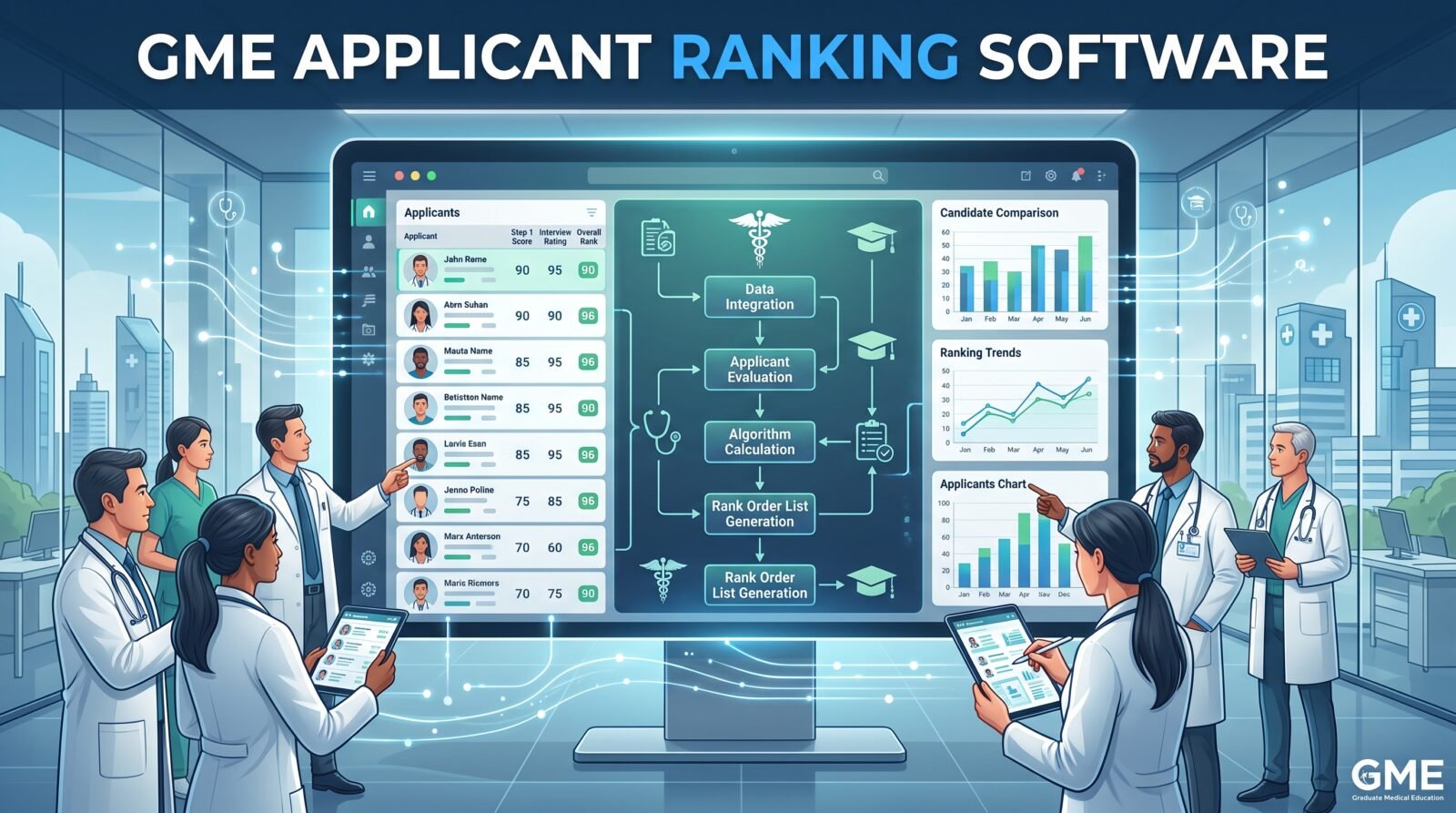
At a basic level, this software usually covers:
- Importing applicant data from ERAS
- Distributing standardized scorecards to interviewers
- Aggregating faculty scores into a single ranked list
- Letting coordinators drag-and-drop reorder candidates before certification
- Exporting a rank list formatted for NRMP submission
- Producing reports for GME office oversight and accreditation documentation
It’s worth being precise here: the NRMP itself does not sell ranking software. The Match algorithm and the R3 system where lists get certified are run by NRMP, but the actual scoring and internal ranking process is where third-party GME applicant ranking software comes in.
Why Programs Are Moving Away from Spreadsheets
Plenty of programs still rank candidates in Excel, and for very small programs that can work fine. But as applicant volume grows, spreadsheets start to show cracks:
- Faculty scores live in different formats, so combining them means manual re-entry
- There’s no audit trail if a score gets changed after the rank meeting
- Bias is harder to control for when reviewers see identifying details they didn’t need to
- Building a clean, exportable rank list for R3 becomes a copy-paste exercise prone to error
Dedicated software addresses these pain points directly, which is part of why interest in this space has grown alongside rising ERAS application volumes in recent Match cycles.
Key Features to Look for in GME Applicant Ranking Software
Not every platform in this space does the same thing well. Before comparing specific tools, it helps to know which features actually move the needle for a coordinator’s day-to-day workload.
Structured, Customizable Scoring
Look for software that lets your program build its own competency-based rubric rather than forcing a generic template. Programs weigh things like clinical knowledge, communication, and professionalism differently, and your scoring tool should reflect that.
Interview Day Logistics
Ranking rarely happens in isolation from interview scheduling. Tools that combine interview day scheduling, applicant “face sheets,” and faculty score collection in one place cut down on the number of separate systems a coordinator has to manage.
Bias-Reduction Options
Some platforms let programs blind certain applicant details (like undergraduate institution or photos) during scoring, which supports a more standardized review process. This has become a more visible feature as programs face increased scrutiny over holistic and equitable review practices.
Rank List Export Compatible with R3
At the end of the process, your rank list needs to go into NRMP’s R3 system. Software that exports a clean, correctly formatted list rather than requiring manual reformatting saves real time during a period when coordinators are already stretched thin.
Reporting for GME Office and Accreditation Needs
GME offices often need aggregate data for ACGME reporting or institutional oversight. Built-in reporting that doesn’t require rebuilding a report from scratch each cycle is a genuine time-saver.
Comparing GME Applicant Ranking Tools
Several platforms have built a reputation specifically within the GME recruitment space. Here’s a general comparison based on what each is commonly known for always confirm current features directly with the vendor, since functionality and pricing change.
| Tool | Best Known For | Interview Scheduling | Rank List Export | Typical Fit |
|---|---|---|---|---|
| Thalamus | Competency-based scoring, drag-and-drop rank building, bias-reduction screening | Yes | Yes | Programs wanting an all-in-one interview + ranking workflow |
| RezRATE | Full recruitment suite covering screening through ranking | Yes | Yes | Programs wanting one platform for the whole interview season |
| Spreadsheet/manual tracking | Full customization, no licensing cost | Manual | Manual reformatting needed | Very small programs with low applicant volume |
This isn’t an exhaustive list of every tool on the market, and new entrants appear most years. Treat any comparison table, including this one, as a starting point for your own demo requests rather than a final verdict a platform that’s a great fit for a 6-resident family medicine program may not suit a 40-resident internal medicine program.
Benefits and Limitations
Benefits
- Cuts down the manual work of consolidating faculty scores
- Creates a documented, defensible scoring process for accreditation purposes
- Speeds up the path from “last interview day” to “certified rank list”
- Reduces the risk of transcription errors when building the final ROL
Limitations
- Licensing costs can be a real barrier for smaller or lower-resourced programs
- Software introduces a learning curve for faculty who are used to paper scorecards
- No platform removes the subjectivity of human evaluation it organizes it, but doesn’t eliminate reviewer bias entirely
- Integration hiccups with ERAS data imports do happen and can cost time during a season with little slack
Common Mistakes to Avoid When Choosing GME Applicant Ranking Software
Picking a tool based on price alone. A cheaper platform that doesn’t integrate cleanly with your ERAS export or R3 submission format can end up costing more in coordinator hours than a pricier, better-integrated one.
Skipping a faculty trial run. Faculty who dislike a scoring interface will resist using it consistently, which undermines the whole point of standardized scoring. Run a small pilot with a few interviewers before rolling it out program-wide.
Not confirming R3 export compatibility ahead of the rank meeting. Waiting until the certification deadline to test whether your export format works with R3 is a risk not worth taking.
Ignoring bias-reduction settings. If your program cares about standardized, equitable review, make sure to actually configure blinding and scoring rubric options rather than leaving defaults untouched.
Assuming one tool works the same for every specialty. A surgical subspecialty program with tiered interview days has different needs than a single-day psychiatry interview format. Ask vendors for examples from programs similar to yours.
READ MORE: RankRX The Modern Framework for Data-Driven SEO Success
How This Fits Into the Broader Match Timeline
It helps to see where ranking software sits inside the full residency Match calendar. Interviews typically wrap up by late January or early February, the NRMP rank order list window opens in early February, and certification deadlines land in early March. That’s a tight window for coordinators to consolidate scores from dozens of faculty across dozens of applicants which is exactly why software built for this specific workflow tends to save more time than general-purpose tools like shared spreadsheets or generic survey forms.
Conclusion
GME applicant ranking software isn’t a requirement for participating in the Match plenty of smaller programs still get by with spreadsheets and shared drives. But as applicant numbers climb and accreditation bodies expect more documented, standardized review processes, purpose-built tools like Thalamus and RezRATE have become the practical choice for many residency and fellowship programs. The right fit depends less on which tool has the flashiest feature list and more on how well it matches your program’s size, specialty, and existing workflow. Start with a demo, run a small faculty pilot, and confirm R3 export compatibility before committing for a full cycle.
FAQs
Is GME applicant ranking software the same as ERAS?
ERAS is the application intake system used by applicants and programs to submit and receive residency applications. GME applicant ranking software works alongside ERAS, helping programs score and rank applicants after applications and interviews are complete.
Do programs have to use ranking software to participate in the NRMP Match?
Programs can build and submit a rank order list manually through R3. Software simply streamlines the scoring and list-building process before that final submission.
How much does GME applicant ranking software typically cost?
Pricing varies by vendor and is usually based on program size or applicant volume, and most vendors require a direct quote rather than publishing flat rates. It’s best to request pricing directly from vendors since costs change and depend on your program’s scale.
Can this software reduce bias in resident selection?
It can support more standardized, structured review through features like blinded scoring and consistent rubrics, but it cannot fully eliminate human bias. It’s a tool that supports a fairer process, not a guarantee of one.
What happens if our rank list export doesn’t match R3’s format?
Most reputable platforms are built to export in a format compatible with NRMP’s R3 system, but formats and requirements can shift. Always test your export ahead of the certification deadline rather than assuming compatibility.
Which specialties use GME applicant ranking software most?
Larger programs and those with high interview volume such as internal medicine, surgery, and emergency medicine tend to see the biggest time savings, though programs of any size and specialty can use these tools.
For more updates visit: rankrx.co.uk