

You’ve probably noticed the term “agentic AI” popping up everywhere lately in software pitches, LinkedIn posts, even in Google’s own search updates. And if you’re like most site owners and marketers, you’re wondering whether it’s a genuinely new category of technology or just another rebrand of the same chatbot tools you’ve already tried.
It’s a fair question. This piece answers it properly: what is agentic AI and how it works, in plain English, with no hype and no guesswork about things that are still evolving.
What Is Agentic AI?
what is agentic ai and how it works and how it works refers to AI systems that don’t just respond to a single prompt they can plan a sequence of steps, use tools or software to carry them out, check their own results, and keep going until a goal is met. Think of the difference between asking a assistant to “write me an email” versus asking it to “find our top 20 unresponsive leads, draft a follow-up for each, and schedule them to send tomorrow morning.” The second task needs planning, decision-making, and action across multiple steps that’s the agentic part.
Traditional generative AI (like a standard chatbot) mostly does one thing at a time: you ask, it answers. what is agentic ai and how it works and how it works systems are built to work more like a junior employee given a goal, they figure out the steps, use the tools available to them (a calendar, a CRM, a search engine, a piece of code), and adjust their approach if something doesn’t work the first time.
It’s worth being precise here, because the term gets thrown around loosely. Not every “AI agent” on the market today is fully autonomous, and results vary a lot depending on how well the underlying tools and guardrails are built.
How Does Agentic AI Actually Work?
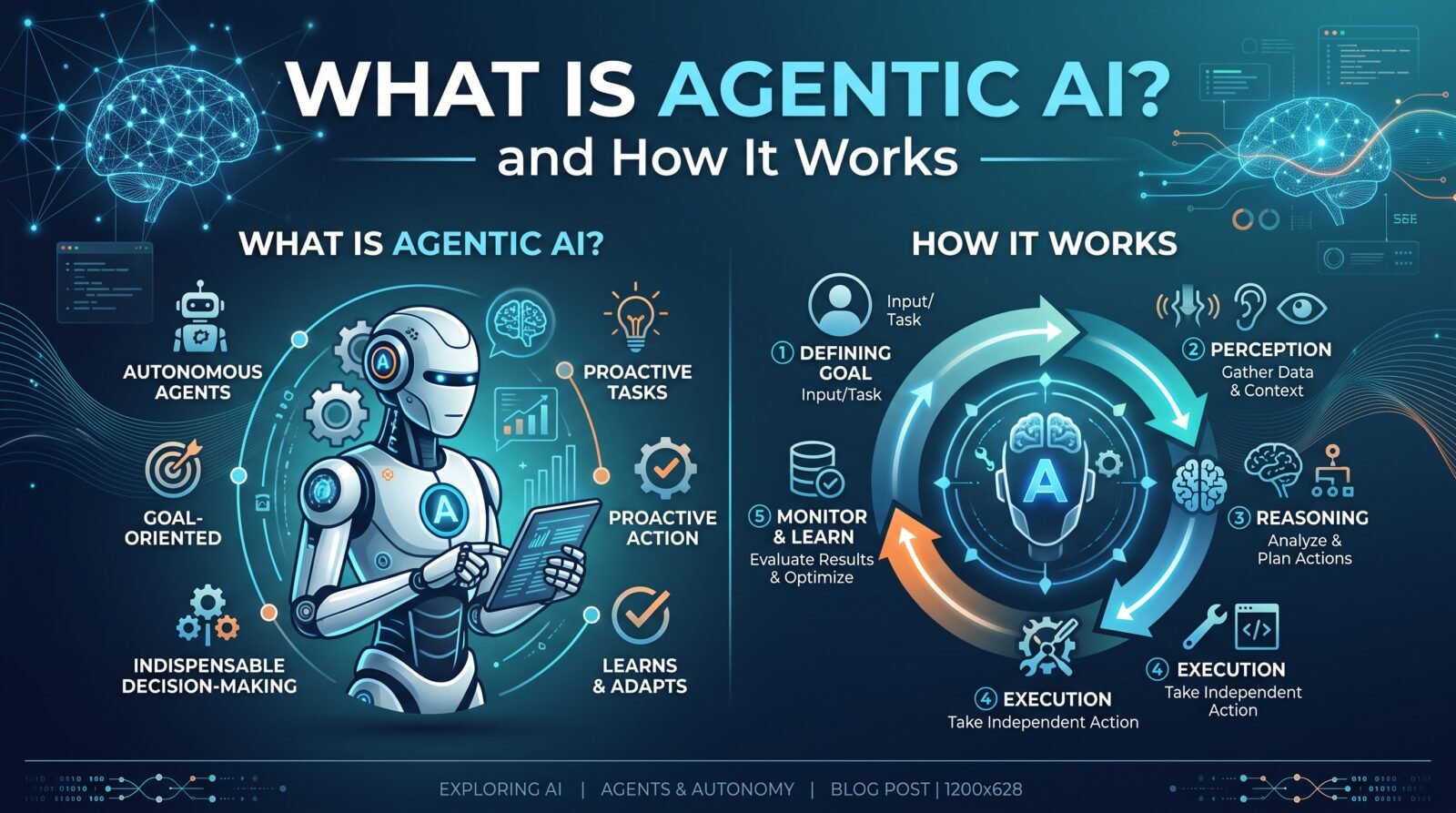
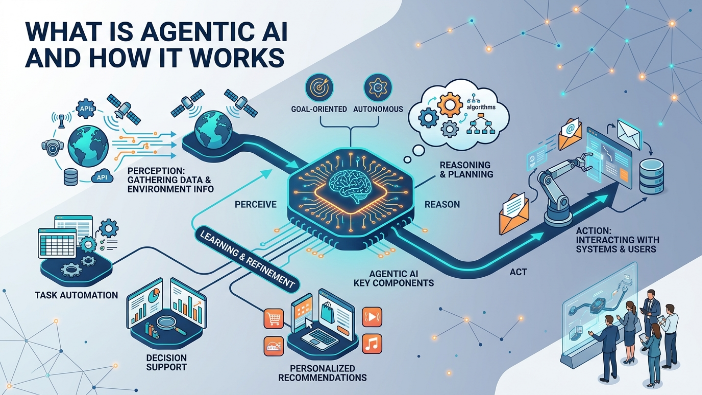
Most what is agentic ai and how it works and how it works systems, regardless of vendor, run on a version of the same basic loop:
- Perceive — the system takes in context: your instructions, data from connected tools, or the state of a task.
- Reason and plan — it breaks the goal into steps, using a large language model (LLM) as the “thinking” engine.
- Act — it carries out a step, usually by calling a tool, an API, a browser, or a piece of software.
- Check and adjust — it reviews what happened and decides whether to continue, retry, or ask a human for approval.
This loop repeats until the task is finished or the system hits a limit it’s been given. That last part matters: well-built agentic systems include guardrails permission settings, spending caps, approval steps for sensitive actions precisely because full autonomy without oversight is where things go wrong.
The Building Blocks Behind Agentic AI
A few components tend to show up in most what is agentic ai and how it works and how it works setups:
- A reasoning model (LLM) — the core “brain” that interprets goals and plans steps.
- Tool access — connections to apps, databases, browsers, or code environments so the system can actually do things, not just talk about them.
- Memory — short-term context for the current task, and sometimes longer-term memory so it can learn from past runs.
- Orchestration — logic that decides which tool to use when, and in what order.
- Guardrails — rules, permissions, and human checkpoints that keep the system from taking actions it shouldn’t.
what is agentic AI and how it works vs Generative AI vs AI Agents: What’s the Difference?
These terms are used interchangeably far too often, which causes real confusion. Here’s a simple breakdown:
| Term | What it does | Example |
|---|---|---|
| Generative AI | Produces content from a prompt (text, images, code) | Writing a blog draft when asked |
| AI agent | A single tool built to complete one type of task with some autonomy | A chatbot that books appointments |
| what is agentic AI and how it works | A system of one or more agents that plans, acts, and adapts across multi-step goals | Researching leads, drafting outreach, sending follow-ups, and reporting results — unprompted at each step |
The short version: generative AI creates, AI agents act on a narrow task, and what is agentic ai and how it works coordinates multiple steps and tools toward a broader goal.
Real-World Examples of Agentic AI in 2026
To make this concrete, here’s where what is agentic AI and how it works is actually being used right now:
- Customer support — resolving tickets end-to-end, escalating only the tricky ones to a human.
- Sales and marketing operations — qualifying leads, personalising outreach, and updating CRM records automatically.
- Software development — writing, testing, and fixing code with minimal manual review.
- Research and analysis — pulling data from multiple sources and producing a synthesised summary or report.
- Search itself — Google has been rolling autonomous “search agents” into AI Mode, letting it carry out multi-step tasks on a user’s behalf rather than returning a single list of links.
That last point matters a lot if you run a website. Search is no longer just about ranking a page — it’s increasingly about whether your content and data can be understood and used by an AI system acting on someone’s behalf.
Why Agentic AI Matters for SEO and Content Strategy
We’d be doing you a disservice if we wrote about agentic AI without connecting it to what most RankRX readers actually care about: getting found.
Two things are happening in Search at once. Google’s regular core updates including the May 2026 core update continue to reward content that’s genuinely useful, accurate, and written with real experience behind it. At the same time, Search itself is becoming more agentic: AI Mode and AI Overviews increasingly summarise, compare, and act on information rather than just linking to it.
Practically, that means:
- Clarity beats cleverness. Content that answers a question directly, with clean structure, tends to get pulled into AI-generated summaries and featured snippets more reliably than vague, keyword-stuffed pages.
- Structured content helps machines and humans alike. Headings, tables, and direct answers aren’t just good for skimming readers — they’re easier for AI systems to parse and cite.
- E-E-A-T signals matter more, not less. As AI systems synthesise answers from multiple sources, demonstrating real experience and accuracy is one of the few ways to stand out and be trusted as a source.
None of this is a guaranteed formula Google’s systems, and the AI layers built on top of Search, are still evolving, and nobody outside Google can say with certainty exactly how much weight any single factor carries.
Benefits and Limitations of Agentic AI
Benefits
- Can handle multi-step tasks without constant supervision, saving time on repetitive work.
- Adapts to changing conditions mid-task rather than failing at the first obstacle.
- Scales certain workflows (research, outreach, monitoring) beyond what a small team could manage manually.
Limitations and risks
- Autonomy without proper guardrails can lead to costly mistakes wrong data sent, wrong actions taken.
- Many agentic AI projects still don’t make it past the prototype stage; reliability at scale is a genuine, unsolved challenge for a lot of organisations.
- Over-trusting an agent’s output without review is a real risk, especially for anything customer-facing or financial.
- The technology and best practices around it are moving fast, so what’s considered “best in class” now may look basic in a year.
Common Mistakes to Avoid With Agentic AI
- Giving an agent too much autonomy too soon. Start with low-risk, reversible tasks before letting a system act without review.
- Skipping guardrails. Permission limits, spending caps, and human checkpoints aren’t optional extras they’re what makes agentic AI safe to use.
- Assuming “agentic” means “accurate.” These systems can still make mistakes or act on wrong assumptions; build in a review step.
- Treating it as a content shortcut. Using agentic tools to mass-produce thin SEO content is a fast way to run into trouble with Google’s people-first content standards.
- Ignoring the learning curve. Teams that get value from agentic AI usually invest time in setting it up properly — it’s rarely plug-and-play from day one.
Conclusion
Agentic AI is a genuine shift in what AI systems can do moving from single responses to multi-step, tool-using action. For anyone running a website or a content strategy, the practical takeaway isn’t to panic or chase every new tool. It’s to keep writing genuinely useful, well-structured, experience-backed content, because that’s exactly what both search engines and the AI systems built on top of them are increasingly designed to reward.
FAQs
Is agentic AI the same as ChatGPT or other chatbots?
Not quite. A standard chatbot generates a response to a prompt. Agentic AI goes further it plans steps, uses tools, and carries out multi-step tasks with less ongoing input from you.
Do I need agentic AI for my small business or website?
Not necessarily. It depends on your workflows. If you have repetitive, multi-step tasks (research, outreach, reporting), it can help. For most content and SEO work, good judgement and solid writing still matter more than the tool you use.
Is agentic AI safe to use for customer-facing tasks?
It can be, but only with proper guardrails permission limits, human review points, and monitoring. Full autonomy without oversight increases risk, especially early on.
How does agentic AI affect SEO?
It’s changing how Search itself works, with AI systems increasingly summarising and acting on content rather than just linking to it. Clear, well-structured, accurate content is more likely to be picked up and trusted by these systems, though no outcome is guaranteed.
What’s the difference between an AI agent and agentic AI?
An AI agent usually handles one narrow task. Agentic AI describes a broader system often multiple agents and tools working together that can plan and complete multi-step goals.
Will agentic AI replace human marketers or writers?
Unlikely in the near term. It’s better understood as a tool that handles repetitive, structured work, freeing people up for strategy, judgement, and the kind of original insight AI systems can’t generate on their own.
For more updates visit: rankrx.co.uk