

Most people don’t lose money on online shopping through one big mistake. They lose it in small leaks a discount code they forgot to check, a delivery fee they didn’t need to pay, a cashback click they skipped because they were in a hurry. On their own, each one feels trivial. Add them up over a year and you’re often looking at hundreds of pounds.
This guide isn’t about extreme couponing or living without the things you want. It’s a practical breakdown of how UK shoppers can save money on online shopping the tools worth using, the ones that overpromise, and the habits that actually make a difference at checkout. We’ve focused on what’s realistic in 2026, including where AI-powered shopping assistants and browser extensions genuinely help and where they don’t. how to save money on online shopping in the uk.
A quick note before we start: prices, retailer terms, and cashback rates change constantly. Treat the specific figures here as illustrative rather than fixed, and always check current terms before you buy.
Why Online Shopping Costs More Than It Should (For Most People)
Retailers spend a lot of effort making full price feel normal. Countdown timers, “only 3 left,” personalised recommendations all of it nudges you toward buying now, at whatever price is shown. Add in delivery charges, subscription creep, and the sheer number of tabs open when you’re comparing prices, and it’s easy to end up paying more than necessary without doing anything obviously wrong. how to save money on online shopping in the uk.
The good news is that most of the savings available to UK shoppers don’t require special skills. They require a system a short, repeatable checklist you run through before you pay. That’s what the rest of this article gives you.
READ MORE: How to Save Money in the UK A Realistic 2026 Guide
Quick Answer: How to Save Money on Online Shopping in the UK
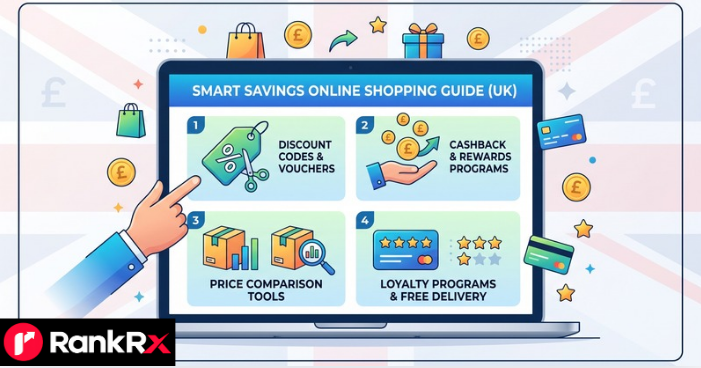
The fastest way to save money on online shopping in the UK is to stack four things at every checkout: a genuine voucher code, cashback through a site like TopCashback or Quidco, a loyalty or student discount if you qualify, and price-comparison history to confirm the deal is actually good. None of these alone saves much stacked together, they typically knock 10–25% off a purchase. how to save money on online shopping in the uk.
Start With Price History, Not the Sale Badge
Before anything else, check whether the “deal” is actually a deal. UK retailers are legally required under the Digital Markets, Competition and Consumers Act to show a genuine reference price, but that doesn’t stop inflated “was” prices from slipping through, particularly around Black Friday and Boxing Day. how to save money on online shopping in the uk.
How to check:
- Use a price-tracking tool such as CamelCamelCamel (for Amazon) or Keepa to see a product’s actual price history over the past 3–6 months. how to save money on online shopping in the uk.
- For non-Amazon retailers, a quick search for the product name plus “price history” often turns up a tracker or a recent review mentioning the typical price. how to save money on online shopping in the uk.
- Compare the current price across two or three retailers using a shopping comparison site like Google Shopping or PriceRunner before assuming the one you’re on is cheapest. how to save money on online shopping in the uk.
This single step stops you falling for the most common online shopping trick: a “40% off” badge on a price that was quietly raised the week before the sale.
Stack Cashback Sites With Voucher Codes
Cashback and voucher codes solve different problems, and using only one leaves money on the table.
Cashback sites pay you a percentage of what you spend, funded by the commission the retailer pays the cashback site for sending you there. In the UK, the two dominant platforms are TopCashback and Quidco. Both are free to join, and most experienced savers hold accounts with both rather than picking one, because the better rate genuinely swaps between them depending on the retailer and the day. TopCashback tends to publish the higher headline rate more often, especially on insurance, broadband, and financial products, while Quidco has a reputation for smoother tracking on some retailers. Neither wins consistently enough to justify only using one.
Voucher and discount codes reduce the price at checkout directly. Browser extensions such as Honey, CouponBirds, or the UK-focused VoucherCodes can auto-apply codes at checkout, but they don’t always find the best one — codes shared on retailer-specific forums or a quick manual search for “[retailer name] discount code [month] [year]” sometimes beat what the extension surfaces. how to save money on online shopping in the uk.
READ MORE: What Is an ISA Account UK A Plain-English Guide for 2026/27
How to Stack Them Correctly
- Add the item to your basket. how to save money on online shopping in the uk.
- Open a cashback site (TopCashback or Quidco), search for the retailer, and click through their link — this is what activates tracking, so do it before you go to the retailer’s site.
- On the retailer’s site, apply a voucher code at checkout, either manually or through a browser extension.
- Complete the purchase. Cashback should track automatically, though it can take a few minutes to appear as “pending” in your account. how to save money on online shopping in the uk.
A common mistake here is opening a voucher-code extension after clicking through a cashback link — some extensions redirect you through their own affiliate link in the process, which can break the cashback tracking. If you use both, click through cashback first, then apply the code once you’re already on the retailer’s site.
| Method | What it saves | Typical saving | Best for |
|---|---|---|---|
| Cashback sites | % back on total spend | 1–10%, higher on insurance/travel | Big-ticket or recurring purchases |
| Voucher codes | Direct price reduction | 5–20%, varies hugely | First orders, clearance stock |
| Loyalty/reward schemes | Points redeemable later | 1–5% effective | Regular shoppers at one retailer |
| Student/NHS/Blue Light discounts | Direct price reduction | 10–20% at participating retailers | Eligible shoppers only |
| Browser price-comparison tools | Confirms genuine lowest price | Varies (prevents overpaying) | Any purchase over ~£30 |
Use Loyalty Schemes and Membership Discounts — But Do the Maths
Loyalty schemes like Tesco Clubcard, Boots Advantage Card, or Sainsbury’s Nectar can meaningfully reduce your shopping bill, particularly on groceries and household items, because many now offer personalised prices rather than flat points. The catch is that “personalised” pricing works both ways — it can nudge you toward items you weren’t planning to buy because the discount looks good in the moment. how to save money on online shopping in the uk.
Paid memberships (Amazon Prime, ASOS Premier, subscription boxes) are only worth it if you genuinely use the core benefit often enough. A rough rule of thumb: if the annual saving from free delivery or discounted items doesn’t clearly exceed the membership fee based on your last three months of actual spending, it’s not paying for itself yet — even if it feels convenient. how to save money on online shopping in the uk.
Blue Light Card, UNiDAYS, and Student Beans are worth setting up if you’re eligible (NHS, emergency services, armed forces, or students), since they unlock discounts of 10–20% at hundreds of UK retailers that aren’t available any other way. Verification usually takes a day or two, so it’s worth doing before a big purchase rather than at the checkout itself. how to save money on online shopping in the uk.
Time Your Purchases Around UK Sale Cycles
Retail sale timing in the UK is fairly predictable, and buying outside these windows — unless you genuinely need something immediately — usually means paying more than necessary. how to save money on online shopping in the uk.
- January sales: Best for homeware, fitness equipment, and post-Christmas clearance.
- Black Friday / Cyber Monday (late November): Best for electronics and tech, though not every “deal” beats the item’s price earlier in the year — this is exactly where price-history checking matters most.
- End-of-season clearance (late June/July and late December): Best for clothing, as retailers clear stock ahead of new seasonal ranges. how to save money on online shopping in the uk.
- Amazon Prime Day (typically July): Best for Amazon-exclusive electronics and household brands, but worth cross-checking against non-Amazon retailers first. how to save money on online shopping in the uk.
If you’re not under time pressure, setting a price alert (through CamelCamelCamel, Google Shopping, or a retailer’s own “notify me” feature) and waiting for one of these windows is one of the simplest ways to cut costs without any extra effort at checkout. how to save money on online shopping in the uk.
Cut Delivery and Returns Costs
Delivery charges are one of the most avoidable costs in UK online shopping, and returns costs are becoming less avoidable as more retailers start charging for them. how to save money on online shopping in the uk.
Delivery:
- Check whether the retailer has a minimum spend for free delivery, and whether it’s worth adding a small item to hit that threshold rather than paying a delivery fee on a smaller order.
- Click & Collect is usually free even when home delivery isn’t, and skips missed-delivery hassle entirely.
- If you shop with a retailer regularly, check whether a delivery pass (like ASOS Premier or a supermarket’s delivery subscription) pays for itself based on your actual order frequency, not how often you think you’ll order.
Returns:
- A growing number of UK retailers (including some major fashion brands) now charge for returns unless you use in-store drop-off. Check the returns policy before buying, not after you’ve decided the item doesn’t fit.
- Keep return windows in your calendar — many are 14–30 days, and missing the window is one of the most common ways shoppers lose money on items they never intended to keep.
READ MORE: How AI Residency Application Screening Is Transforming Medical Recruitment Strategy
Should You Use AI Shopping Assistants and Deal-Finder Tools?
By 2026, AI-powered browser assistants and shopping comparison tools have become common, and they can genuinely help — with caveats worth knowing before you rely on one.
What they’re good at:
- Summarising price history and reviews faster than doing it manually across multiple tabs.
- Flagging when a “deal” price isn’t actually lower than the item’s recent average.
- Auto-searching for voucher codes at checkout, saving you the manual step.
Where to be careful:
- Some deal-finder extensions are paid by retailers to prioritise certain products or codes, which isn’t always disclosed clearly. Treat “recommended” deals with the same scepticism you’d apply to a sponsored search result.
- AI shopping summaries can occasionally misstate a price or stock status pulled from an outdated page — always confirm the final price on the retailer’s actual checkout page before paying.
- No tool replaces the basic habit of checking price history yourself for anything over roughly £50; automated tools are a shortcut, not a guarantee.
Used as one input among several — alongside cashback, voucher codes, and price history — these tools save time. Used as the only check, they can occasionally lead you to a “deal” that isn’t one.
Common Mistakes to Avoid
- Skipping the cashback click because you’re in a rush. It takes 15 seconds and there’s rarely a good reason not to do it if you’re buying anyway.
- Trusting the “was” price without checking history. Reference prices aren’t always what they claim to be, especially around major sale events.
- Signing up for a paid membership based on one big order. Check whether your actual ongoing spending justifies the fee, not the one purchase that made you consider it.
- Applying a voucher code after cashback tracking has already broken. Order matters — cashback link first, code second.
- Ignoring returns policies until after buying. A “final sale” or paid-returns item can turn a good deal into a bad one if it doesn’t fit or work.
- Assuming every AI-recommended deal is unbiased. Some tools are commercially incentivised to point you toward specific retailers or codes.
A Simple Checklist Before You Checkout
- Checked price history over the last 1–3 months
- Clicked through a cashback site (TopCashback or Quidco) before visiting the retailer
- Searched for a current voucher code, either manually or via an extension
- Checked eligibility for loyalty, student, or Blue Light discounts
- Confirmed delivery cost and whether Click & Collect is free
- Read the returns policy, including whether returns are free
- Confirmed the final checkout price matches what you expected before paying
Conclusion
None of these tactics is dramatic on its own. Cashback might save you a few pounds. A voucher code might knock off a bit more. Checking price history stops you overpaying for a fake discount. But run through the checklist consistently, and the savings compound — often to 10–25% off a typical online order, more on big-ticket items like insurance or electronics. The people who save the most on UK online shopping aren’t chasing rare, secret deals. They’re just consistent about the basics, every time they shop.
READ MORE: Best Netflix Shows UK August 2026 The Top Streams
Results will vary depending on what you buy, which retailers you use, and how much time you’re willing to put in — there’s no single formula that works identically for everyone.
FAQs
Is TopCashback or Quidco better for UK shoppers?
Neither wins consistently. TopCashback tends to publish higher headline rates more often, particularly on insurance and financial products, while Quidco has a reputation for smoother tracking on some retailers. Most experienced UK cashback users hold accounts with both and check whichever pays more before a purchase.
Do browser extensions like Honey actually save money?
They can save time by auto-applying codes at checkout, but they don’t always find the best available code, and some are paid to prioritise certain retailers or offers. Treat them as one tool among several rather than the only check you do.
Is it worth paying for Amazon Prime or similar memberships just to save money?
Only if your actual order frequency justifies the fee. Look at your last three months of spending with that retailer and compare the delivery savings and discounts you’d realistically use against the membership cost — not the one big order that made you consider it.
When are UK online sales usually the best value?
January (homeware, fitness), Black Friday/Cyber Monday (electronics), end-of-season clearance in late June/July and late December (clothing), and Amazon Prime Day in July (Amazon-exclusive tech). Even during these windows, check price history, since not every “deal” beats the item’s price earlier in the year.
How do I stack cashback and voucher codes without breaking the tracking?
Click through the cashback site link first, then apply the voucher code once you’re already on the retailer’s site. Applying a code through a browser extension before the cashback link is fully tracked can sometimes interrupt it.
Are AI shopping assistants reliable for finding the best price?
They’re a useful shortcut for summarising price history and reviews, but they can occasionally pull outdated prices or prioritise sponsored deals. Always confirm the final price on the retailer’s actual checkout page before paying, especially for purchases over roughly £50.
For more updates visit: rankrx.co.uk