
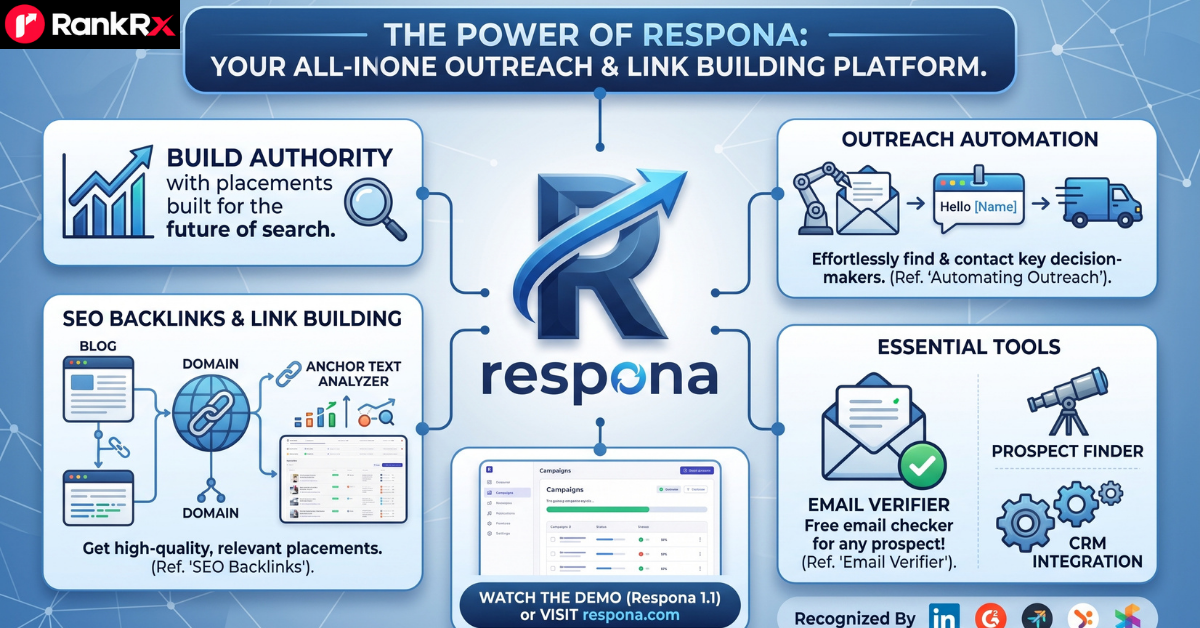

Link building is easy to understand and surprisingly difficult to execute well. Finding worthwhile websites is only the beginning. Respona You still need the right contact, a credible pitch, follow-ups, relevant content and, most importantly, a reason for another publisher to link to you.
That is the problem Respona is built around.
But there is an important detail that can be missed if you are reading older reviews: the platform has evolved. In 2026, Respona increasingly positions itself as a done-for-you link-building and digital PR service rather than simply another outreach dashboard. You choose the pages you want to promote and define your requirements, while its team handles prospecting, outreach, negotiation and placement.
That makes it interesting for businesses that understand the value of backlinks but do not want to spend hours managing outreach campaigns.
Disclaimer: SEO results vary by website, industry, competition, content quality and many other factors. Product features, pricing and search behaviour can change, so verify current details before making purchasing or SEO decisions. For a site-specific campaign, consider reviewing the strategy with an experienced SEO professional.
So, is it worth using?
The answer depends on how much control you want, how competitive your SEO market is and whether you would rather build links yourself or pay for the work to be handled for you.
What Is Respona?
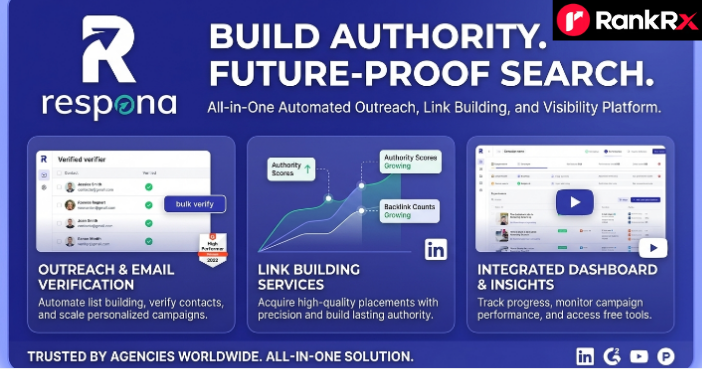
Respona is a link-building and digital PR platform designed to help businesses find relevant publishing opportunities and earn backlinks.
Its current offering combines link-building execution with prospect discovery, outreach and AI-oriented search visibility features. The company says users can provide target pages, keywords, anchor-text preferences and other requirements, after which its team handles much of the outreach process.
The platform has also expanded its Campaigns functionality around AI search. According to Respona’s current documentation, campaigns can identify articles ranking for target keywords and pages appearing in AI-generated answers, giving marketers another way to identify publications worth pursuing.
In practical terms, there are two ways to think about the product:
- Link acquisition: Find and secure relevant backlinks.
- Outreach execution: Reduce the manual work involved in contacting publishers.
- Digital PR: Help brands get mentioned by relevant websites.
- AI visibility research: Identify content appearing in AI-generated search answers.
- Campaign management: Keep link-building requirements and opportunities organised.
The important distinction is that a backlink is not automatically valuable because it exists.
A link from a relevant article on a genuinely useful website can make sense for users and may support your site’s authority. A large pile of unrelated links created purely to manipulate rankings is a very different proposition.
That distinction matters even more after Google’s recent emphasis on helpful, reliable and non-commodity content.
How Respona Works
The basic workflow is straightforward.
1. Choose the pages you want to promote
Start with the pages on your website that actually deserve links.
That might be:
- An original research article
- A detailed industry guide
- A useful software comparison
- A product page
- A statistics or data resource
- A technical tutorial
- A digital PR asset
READ MORE: What Is Agentive AI A Practical Guide for Marketers and Site Owners
This step is more important than it sounds.
If the underlying page is weak, outreach becomes an uphill battle. You can contact hundreds of publishers, but there is little reason for them to recommend something that adds no value to their readers.
2. Define your link requirements
Your requirements can include the target URL, preferred anchor text, niche, exclusions and other placement preferences.
This gives you more control over what kind of website you are trying to reach.
For example, a cybersecurity software company might prefer:
Cybersecurity publications, SaaS websites, IT management blogs and technology publications with relevant organic traffic.
That is much more useful than simply asking for “high-authority backlinks.”
Metrics can help filter opportunities, but relevance should remain part of the decision.
3. Find suitable opportunities
This is where outreach software can save a substantial amount of manual research.
Instead of opening search results one by one, building spreadsheets and hunting for contact details manually, the platform is designed to streamline prospect discovery and contact research.
Its current Campaigns feature also looks for articles that already perform in search and appear in AI-generated answers for relevant queries.
That creates an interesting angle for modern SEO.
Rather than asking only:
“Which websites have authority?”
you can also ask:
“Which pages are already influential for the audience and topics I care about?”
Those are not always the same thing.
4. Outreach and negotiation
Once opportunities are identified, the outreach process begins.
Respona’s current done-for-you model handles prospecting, outreach, follow-ups, publisher negotiations and placement.
That is the biggest difference between the current service and a traditional self-managed outreach tool.
You are not simply buying software and then doing everything yourself.
You are outsourcing a significant part of the workflow.
5. Review the placement
A successful link-building campaign should not end with “a backlink was delivered.”
Look at the actual placement.
Ask:
- Is the website relevant to my audience?
- Does the article make sense for the link?
- Is the page indexed?
- Does the publication appear legitimate?
- Does the placement look editorial?
- Is the surrounding content useful?
- Would a real reader potentially click the link?
These questions are more meaningful than a single third-party authority score.
Respona Features Worth Knowing
The platform’s feature set is best understood by looking at the problems it tries to remove from the outreach process.
| Feature | What it helps with | Why it matters |
|---|---|---|
| Prospect discovery | Finding potential publishing opportunities | Reduces manual research |
| Contact discovery | Identifying relevant people | Makes outreach more targeted |
| Outreach management | Managing communication | Keeps campaigns organised |
| Personalisation | Creating more relevant pitches | Helps avoid generic emails |
| Follow-ups | Continuing conversations | Reduces missed opportunities |
| Link placement | Securing backlinks | Delivers the core campaign outcome |
| Campaigns | Researching search and AI visibility opportunities | Connects link building with modern search |
| Pre-approval | Reviewing prospects before outreach | Adds another layer of control |
| Reporting | Monitoring campaign activity | Makes campaigns easier to evaluate |
Respona’s own documentation describes contact discovery and personalised outreach as central parts of its workflow. Its software pages also describe automated contact research and AI-assisted snippets for personalising pitches.
For a small marketing team, removing repetitive research can be more valuable than adding another dozen SEO metrics.
Respona Pricing in 2026
Pricing is one area where older reviews can quickly become misleading.
The current done-for-you model uses a per-placement structure based largely on the quality tier of the publishing website. Respona’s current pricing documentation lists the following standard tiers:
| Tier | Minimum DR | Listed price per placement |
| Starter | 20+ | $100 |
| Standard | 30+ | $160 |
| Authority | 40+ | $240 |
| Power | 50+ | $400 |
| Elite | 60+ | $500 |
Respona says the tiers also use estimated organic traffic requirements, with higher-quality placements costing more.
That makes the pricing model easy to understand:
You pay for placements rather than committing to a conventional monthly SEO retainer.
However, price should not be the only factor.
A $100 backlink from a highly relevant publication that attracts the right audience can be more useful than a supposedly stronger link from an unrelated website.
Likewise, paying $500 for a link does not guarantee that your rankings will increase.
Google rankings depend on many signals, and no legitimate link-building provider can guarantee a particular ranking outcome.
Is Respona Worth It?
For the right business, it can be.
For someone who enjoys running their own outreach campaigns and already has the systems, contact databases and staff to handle negotiations, paying for a done-for-you service may not make as much sense.
For a company with limited marketing resources, the calculation changes.
Consider the time involved in doing the process manually:
- Research prospects.
- Check their relevance.
- Find contact information.
- Build outreach lists.
- Write personalised emails.
- Send follow-ups.
- Manage replies.
- Negotiate placements.
- Create or edit content.
- Track published links.
That can become a substantial operational task.
Respona’s current model is designed to take much of that work off the marketer’s plate.
Respona may be a good fit if you:
- Need backlinks but lack an outreach team
- Run an SEO agency
- Manage several client websites
- Want a more structured link-acquisition process
- Prefer paying per placement
- Want control over placement requirements
- Need help with publisher outreach
- Want to explore AI-search visibility alongside traditional SEO
It may be less suitable if you:
- Want complete control over every email
- Already have a strong in-house outreach team
- Need a broad all-in-one SEO platform
- Primarily want keyword research or technical SEO tools
- Have a very limited link-building budget
- Prefer building publisher relationships personally
Respona vs Other Link-Building Tools
There is no universal “best” outreach platform.
The right choice depends on whether you want software, a CRM-style workflow or an outsourced service.
G2’s current alternatives data commonly places Respona alongside tools such as BuzzStream and Pitchbox, while other options focus more heavily on influencer discovery or media relations.
| Tool | Best suited to | Main strength |
| Respona | Done-for-you link acquisition | Outsourced outreach and placements |
| BuzzStream | Relationship-led outreach | Outreach CRM and contact management |
| Pitchbox | Larger outreach operations | Campaign automation |
| Ahrefs | SEO professionals | Backlink and competitive research |
| Semrush | Broader SEO teams | All-round SEO and marketing toolkit |
This is an important comparison because these products are not identical.
Respona vs BuzzStream
BuzzStream is more focused on relationship management and outreach operations. It gives teams a way to organise contacts, campaigns, emails and relationship history.
Respona’s current positioning is more outcome-oriented: you define what you want and its team handles much of the execution.
If your question is:
“Which software should my outreach team use?”
BuzzStream may deserve consideration.
If the question is:
“How can I get the outreach work handled without building the entire process internally?”
Respona becomes more interesting.
Respona vs Pitchbox
Pitchbox is another established platform for outreach campaign management and automation.
G2 currently lists Pitchbox as a frequently considered alternative to Respona and reports strong user ratings for both products.
The practical distinction is again about workflow.
Pitchbox is attractive for teams that want to operate their own outreach machine.
Respona’s current offering makes more sense when you want to outsource much of that machine.
Respona vs Ahrefs
This comparison needs a little caution because Ahrefs solves a broader SEO problem.
Ahrefs can be used for:
- Keyword research
- Backlink analysis
- Competitor research
- Content research
- Site auditing
- Rank tracking
That makes it a powerful research platform.
But Ahrefs is not simply a replacement for a done-for-you link-building service.
You could use an SEO platform such as Ahrefs to identify backlink opportunities and then use an outreach service to pursue them.
In fact, the two approaches can complement each other.
The Biggest Advantage: Less Manual Work
The strongest case for Respona is not that it has a magic button for rankings.
It doesn’t.
The appeal is operational.
Link building contains a lot of repetitive work that has little strategic value.
Finding the right person at a company can take time. Checking websites can take time. Writing follow-ups can take time. Tracking conversations can take time.
A structured platform and service can compress that workflow.
That gives marketers more time to work on the part that software cannot replace easily:
creating something worth linking to.
That last point deserves emphasis.
The quality of your underlying content still matters.
If your website contains thin product pages, generic blog posts and recycled advice, a better outreach system will not magically transform the site into an authoritative resource.
The Biggest Limitation: You Still Need Judgment
Automation can speed up prospecting.
AI can help with personalisation.
Neither replaces editorial judgment.
A publisher may look impressive by metrics but have little relevance to your business.
A website may have strong apparent authority while attracting an audience that has no interest in your product.
An article may rank well but have little commercial relevance.
That is why link-building decisions should not be reduced to Domain Rating, Domain Authority, traffic estimates or any other third-party metric.
Use metrics as filters.
Use relevance, editorial quality and audience fit as decision-making inputs.
Link Building After Google’s 2026 Updates
The timing of this discussion matters.
Google’s May 2026 core update ran from May 21 through June 2, according to Google’s Search Status Dashboard.
Google also published new guidance in May on optimising for generative AI features in Search. The guidance emphasises valuable, unique content and makes clear that established SEO fundamentals remain relevant for AI features.
That leads to a useful conclusion for link builders.
You do not need an entirely separate “AI SEO” version of link building.
You need a stronger version of traditional SEO.
That means:
- Create content people actually want to reference.
- Earn mentions from relevant sources.
- Build genuine topical authority.
- Make important information easy to understand.
- Avoid mass-produced, low-value pages.
- Think about users, not just crawlers.
- Build a recognisable brand rather than a collection of backlinks.
Google’s June 2026 Search Console changes also moved further toward measuring visibility in generative AI experiences. Google announced dedicated reporting for visibility in AI Overviews and AI Mode, initially rolling those reports out to a subset of sites.
For marketers, that means search visibility is becoming broader than a traditional list of ten blue links.
But the fundamental principle has not changed:
Earn attention by publishing something useful.
How to Use Respona Without Wasting Your Budget
If you decide to use a link-building service, do not start by ordering as many links as possible.
Start with a strategy.
Step 1: Pick pages that deserve links
Choose pages that support a real business objective.
A strong target might be:
- A high-value service page
- An original research report
- A detailed guide
- A useful resource
- A comparison page
- A proprietary data page
Step 2: Define your ideal publication
Don’t simply say “high authority.”
Specify:
- Industry
- Audience
- Geography
- Minimum traffic
- Relevant topics
- Acceptable publication types
- Websites you want excluded
The more clearly you define the target, the easier it becomes to judge the result.
Step 3: Set realistic anchor-text expectations
Avoid forcing the exact same commercial keyword into every backlink.
Natural backlink profiles contain variation.
You may see:
- Brand names
- Naked URLs
- Generic phrases
- Partial-match phrases
- Descriptive anchors
- Occasionally, exact-match commercial terms
The goal should be a natural editorial profile, not an artificially engineered pattern.
Step 4: Review prospects before scaling
If your budget allows, test the process before committing to a larger campaign.
Look at the websites being offered.
Check:
- Relevance
- Organic visibility
- Content quality
- Publishing patterns
- Outbound-link behaviour
- Audience fit
- Traffic quality
If the prospects are poor, increasing volume will not solve the problem.
Step 5: Measure more than rankings
Track:
- Referring domains
- Referral traffic
- Target-page visibility
- Organic clicks
- Relevant keyword movement
- Brand mentions
- Conversions where measurable
- AI-search visibility where relevant
This gives you a much more complete picture.
Common Mistakes to Avoid
Buying links based only on a metric
A high DR or DA number is not enough.
Look at the actual website.
Treating every backlink as equally valuable
A relevant editorial link and an irrelevant link are not interchangeable.
Ordering links before improving content
Your landing page needs to deserve the attention you are trying to generate.
Overusing exact-match anchors
Natural variation is generally more sensible than forcing the same keyword into every placement.
Assuming AI makes outreach automatic
AI can accelerate research and personalisation, but a generic AI-generated pitch is still a generic pitch.
Measuring success only by rankings
Ranking changes can come from many factors. A link campaign should be evaluated using a broader set of business and SEO signals.
Ignoring referral traffic
A good link can send relevant visitors directly, regardless of whether it produces an immediate ranking change.
Forgetting that SEO results vary
Competition, website quality, content depth, technical health, brand strength and many other variables influence outcomes.
There is no universal backlink formula that guarantees a ranking improvement.
A Practical Link-Building Checklist
Before starting a campaign, run through this list.
Content
- Is the target page genuinely useful?
- Does it provide information worth citing?
- Is the page better than the obvious alternatives?
Prospecting
- Are target websites relevant?
- Do they have a real audience?
- Do their articles appear useful rather than mass-produced?
Outreach
- Is the pitch personalised?
- Is there a legitimate reason for the publisher to care?
- Does the suggested link improve the article?
Placement
- Is the backlink contextually relevant?
- Is the article useful?
- Does the placement look editorial?
- Would a reader plausibly click it?
Measurement
- Are you tracking referring domains?
- Are you monitoring referral traffic?
- Are you watching organic visibility?
- Are you connecting SEO activity to business outcomes?
Is Respona Good for Small Businesses?
It can be, particularly when the alternative is spending hours every week managing outreach.
Small businesses often have the opposite problem from large enterprises: they know they need authority and visibility but do not have a dedicated link-building department.
A done-for-you model can fill that operational gap.
The question is whether the expected value of acquiring relevant placements justifies the cost.
For a new website with a tiny marketing budget, spending heavily on backlinks before establishing strong content and technical foundations may be premature.
For an established company with valuable content and a competitive search market, outsourced link acquisition can be easier to justify.
Is Respona Good for Agencies?
This is one of the more interesting use cases.
Agencies often understand link building but do not necessarily want to maintain a large internal outreach operation.
A third-party service can act as fulfilment infrastructure while the agency manages strategy, client communication and reporting.
Respona also explicitly discusses white-label use in its current link-building material, making the agency market part of its positioning.
Still, agencies should maintain quality control.
Your client does not care which vendor sent the outreach email.
They care whether the placement is relevant, legitimate and useful.
If outsourcing creates weak links, the agency owns the reputation problem.
Does Respona Guarantee Better Google Rankings?
No.
And this is an important line to draw.
Backlinks can support SEO, but no legitimate platform can guarantee that a specific link will produce a particular ranking improvement.
Google’s core updates are broad changes to its ranking systems, and Google’s own documentation explains that these systems aim to surface helpful and reliable results rather than reward a single isolated tactic.
Think of link building as one part of a larger SEO system.
You still need:
- Strong content
- Good search intent alignment
- A technically healthy website
- Useful internal linking
- Good page experience
- Clear topical coverage
- Brand credibility
- Sustainable promotion
A backlink can strengthen that system.
It cannot replace it.
Final Verdict
Respona is most compelling when you want link building without having to operate every part of the outreach process yourself.
Its current 2026 model is notably different from the older image of Respona as simply an outreach software dashboard. The company now puts considerable emphasis on done-for-you link acquisition, publisher outreach and placement, while its Campaigns functionality connects traditional search research with visibility in AI-generated answers.
That makes it worth considering for agencies, SaaS companies, publishers and businesses that have strong content but lack the time or staff to run outreach consistently.
The main caution is simple: don’t confuse buying a backlink with buying SEO results.
READ MORE: Rank One in Google A Practical SEO Guide for 2026
The best campaigns begin with useful content, sensible targeting and realistic expectations.
If your website already has something worth referencing, a service like Respona can remove much of the tedious work between publishing that asset and getting it in front of relevant publishers.
If the content itself is weak, fix that first.
SEO rewards useful websites over time, not shortcuts.
Conclusion
The smartest way to evaluate a link-building platform is not to ask how many backlinks it can produce.
Ask whether it can help you earn relevant, credible placements that make sense for real readers.
That is where Respona has a reasonable case in 2026. Its move toward done-for-you outreach makes it particularly relevant for businesses and agencies that want to reduce the operational burden of link acquisition. Its growing focus on AI-search visibility also reflects where search is heading.
But the fundamentals remain stubbornly familiar.
Create something useful. Find the right audience. Earn genuine mentions. Measure what happens. Improve the strategy.
That is a much safer SEO strategy than chasing shortcuts.
FAQs
What is Respona used for?
Respona is used for link building, digital PR and outreach. Its current done-for-you service handles tasks such as prospecting, contact discovery, outreach, follow-ups, publisher negotiation and securing placements.
Is Respona a link-building tool or a service?
It is increasingly positioned as a done-for-you link-building service, although the platform also provides campaign and research functionality. The current model lets users define target pages and requirements while Respona’s team handles much of the execution.
How much does Respona cost?
Current published placement tiers range from $100 for Starter placements to $500 for Elite placements, with pricing based on factors including Domain Rating and estimated organic traffic. Pricing can change, so check the provider’s current pricing before purchasing.
Is Respona better than BuzzStream?
Neither is universally better. BuzzStream is particularly suited to teams that want an outreach CRM and relationship-management workflow, while Respona’s current offering is more focused on having the link-building work executed for you. G2 lists both among commonly compared options.
Can Respona improve SEO rankings?
It can help execute a backlink strategy, but it cannot guarantee ranking improvements. SEO performance depends on content quality, competition, technical factors, search intent, links, brand signals and other ranking systems.
Is link building still important in AI search?
Yes, but it should be viewed as part of a broader authority and content strategy. Google says traditional SEO best practices remain relevant to its generative AI search experiences, while its 2026 guidance also stresses valuable, unique content.
For more updates visit: rankrx.co.uk