
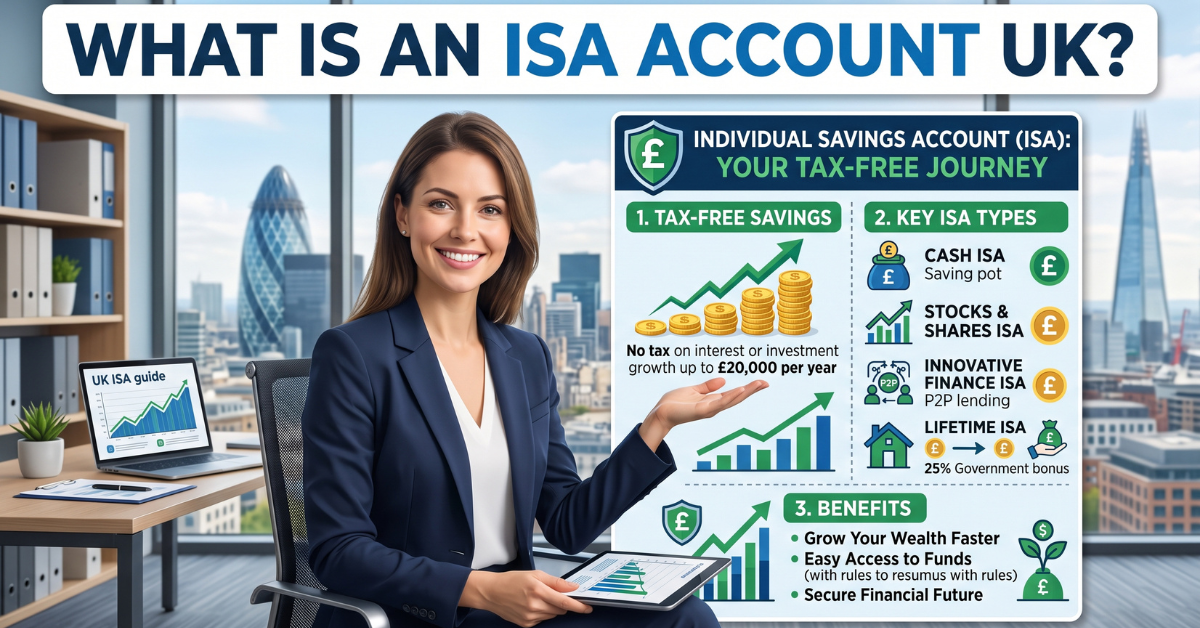

You’ve probably heard people say “just put it in an ISA” like it’s obvious what that means. It isn’t, especially if you’ve never opened one. Here’s the short version before we go deeper: an ISA is simply a savings or investment account where the taxman doesn’t touch your returns. No tax on interest, no tax on dividends, no tax on gains. That’s the whole trick and it’s a legal one. what is a ISA account UK.
This guide walks through what an ISA account UK residents can actually open, how the allowance works, which type suits which goal, and the mistakes that trip people up every April.
What Is an ISA Account UK Savers Use to Avoid Tax?
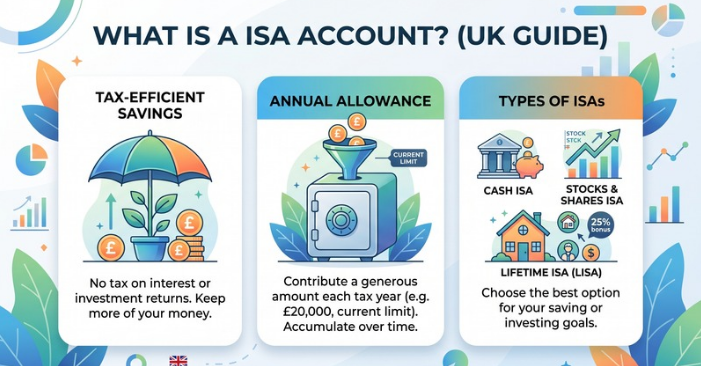
An ISA Individual Savings Account is a tax-free wrapper you can put around your savings or investments. It’s not a product in itself; think of it more like a container. What you put inside that container (cash, shares, funds, peer-to-peer loans) determines which type of ISA you’re using. what is a ISA account UK.
The core benefit is simple: <cite index=”7-1″>outside an ISA, you could be liable to pay Income Tax on savings interest or Capital Gains Tax when you sell investments for a profit, but inside an ISA, that growth is legally yours to keep</cite>. That’s it. Same money, same growth just no tax bill attached.
Every UK resident aged 18 or over gets an annual allowance to pay into ISAs. <cite index=”8-1″>You can pay up to £20,000 into ISAs in your name during the 2026/27 tax year</cite>, and that allowance resets each April.
The Four Types of Adult ISA
Most people assume “ISA” means one product. It doesn’t. <cite index=”2-1″>There are four types: cash ISA, stocks and shares ISA, innovative finance ISA, and Lifetime ISA</cite>, and you can spread your £20,000 allowance across them however suits your goals. what is a ISA account UK.
READ MORE: Best Business Ideas UK 2026 What’s Actually Worth Starting
1. Cash ISA
This works exactly like a normal savings account, except the interest is tax-free. It suits people who want a safe place for an emergency fund or short-to-medium-term savings, where the priority is not losing money rather than chasing growth. what is a ISA account UK.
2. Stocks and Shares ISA
Here your money goes into investments funds, shares, bonds rather than sitting as cash. It carries more risk because markets move, but it’s generally better suited to long-term goals (five years or more), where the potential for growth outweighs short-term ups and downs.
3. Innovative Finance ISA (IFISA)
A lesser-known option that wraps peer-to-peer lending investments. You’re effectively lending money to individuals or businesses through a platform and earning tax-free interest. It’s higher risk than a Cash ISA and isn’t covered by the same protections as bank deposits, so it’s worth understanding fully before committing money here.
4. Lifetime ISA (LISA)
Designed specifically for first-time buyers or retirement saving. <cite index=”4-1″>You need to be between 18 and 39 to open one, though you can keep contributing until you turn 50, and the government adds a 25% bonus worth up to £1,000 a year on top of what you pay in</cite>. The catch: <cite index=”3-1″>withdrawals outside the qualifying reasons carry a 25% charge</cite>, and the money can only go towards a first home or come out from age 60 for retirement. what is a ISA account UK.
There’s also a Junior ISA (JISA) for under-18s, which sits entirely separate from the adult allowance.
ISA Allowance Table (2026/27)
| ISA Type | Annual Limit | Who It’s For |
|---|---|---|
| Overall adult ISA allowance | £20,000 (combined across types) | All UK residents 18+ |
| Cash ISA | Up to full £20,000 | Short-term savers, emergency funds |
| Stocks and Shares ISA | Up to full £20,000 | Long-term growth investors |
| Innovative Finance ISA | Up to full £20,000 | Higher-risk, peer-to-peer lenders |
| Lifetime ISA | £4,000 (counts within the £20,000) | First-time buyers, retirement savers aged 18–39 |
| Junior ISA | £9,000 (separate allowance) | Under-18s, opened by a parent or guardian |
<cite index=”4-1″>All four adult ISA types draw from the same £20,000 pot, except the Lifetime ISA, which is capped at £4,000 within it</cite>. Meanwhile, <cite index=”6-1″>from 6 April 2027, under-65s will be able to save £12,000 in a Cash ISA</cite> as part of a planned change to the cash allocation worth knowing if you’re planning ahead, though the overall £20,000 total limit stays the same. what is a ISA account UK.
How the Allowance Actually Works
A few rules catch people out every year:
- It’s “use it or lose it.” <cite index=”7-1″>Your allowance resets every year at midnight on 5 April, and you cannot roll over unused allowance into the following tax year</cite>.
- It’s per person, not per household. <cite index=”5-1″>There isn’t a joint ISA allowance for married couples, since ISAs can only be held in one person’s name you and your spouse or civil partner each get your own £20,000 allowance</cite>. what is a ISA account UK.
- You’re not limited to one ISA. <cite index=”5-1″>There’s no limit on the number of ISAs you can have</cite>, and <cite index=”4-1″>since the April 2024 rule change, you can hold and pay into more than one ISA of the same type in a single tax year</cite> something that wasn’t allowed before. what is a ISA account UK.
- Only new money counts. <cite index=”4-1″>Only new contributions made during the tax year count towards the £20,000 limit</cite> transferring an existing ISA balance between providers doesn’t eat into your allowance.
Cash ISA vs Stocks and Shares ISA: Which Should You Pick?
There’s no single right answer here it depends on your timeframe and appetite for risk.
Choose a Cash ISA if:
- You need the money within the next few years
- You want zero risk of losing your capital
- You’re building an emergency fund
Choose a Stocks and Shares ISA if:
- You’re investing for five years or longer
- You’re comfortable with values going up and down
- You’re aiming for growth that outpaces inflation over time
Many people end up using both a Cash ISA for accessible savings and a Stocks and Shares ISA for long-term goals like retirement. Since your allowance can be split across types, this isn’t an either/or decision.
Who Can Open an ISA?
<cite index=”5-1″>Only UK residents, members of the armed forces, and Crown Servants (along with their spouses or civil partners) aged 18 or over can open an adult ISA and qualify for the allowance</cite>. If you move abroad permanently, you generally can’t pay into a new ISA, though existing ISAs can often stay open and keep their tax-free status. what is a ISA account UK.
Common Mistakes to Avoid
- Letting the allowance go to waste. Because it doesn’t roll over, delaying until March and forgetting is a genuinely costly habit.
- Putting long-term money in cash “to be safe.” Cash feels safe, but low interest rates can mean inflation quietly erodes value over many years.
- Withdrawing from a Lifetime ISA for the wrong reason. <cite index=”4-1″>The 25% government bonus comes with strings attached early withdrawal for anything other than a first home or retirement triggers a charge</cite> that can leave you with less than you paid in.
- Assuming ISAs are inheritance-tax-free. <cite index=”5-1″>While you can leave an ISA’s value to a family member or friend in your will, it forms part of your estate and can be liable for Inheritance Tax</cite> — though a surviving spouse or civil partner does get a temporarily increased allowance to shelter that money.
- Not shopping around. Interest rates and platform charges vary a lot between providers, and loyalty rarely pays in this space.
READ MORE: 10 Best Business Ideas in the UK for 2026 (High-Margin & Low Overhead)
The Upside and the Limits
ISAs are genuinely one of the simplest tax-efficient tools available to UK savers there’s no paperwork at tax return time, no forms to fill in for HMRC, and the tax saving is automatic. That said, they’re not a magic fix. The £20,000 annual cap means high earners or big savers will eventually need other tax planning options too, and investment-based ISAs still carry market risk tax-free doesn’t mean risk-free. As with most financial decisions, what works well for one person’s goals and timeline won’t necessarily suit another’s, so it’s worth treating this as a starting point rather than a final answer.
Conclusion
An ISA account UK savers use is, at its core, a tax-free wrapper not a single product, but a choice of four (plus a Junior version for kids). Whether you go for the safety of a Cash ISA, the long-term growth potential of a Stocks and Shares ISA, the specific purpose of a Lifetime ISA, or a mix of all three, the underlying benefit stays the same: your returns stay entirely yours, with no tax bill attached. The most important habit isn’t picking the “perfect” ISA — it’s actually using the allowance before it resets each April.
FAQs
Is an ISA better than a normal savings account?
For tax purposes, yes interest in an ISA is tax-free, while interest outside one may be taxable once you exceed your Personal Savings Allowance. Which is “better” for you also depends on the interest rate offered, since some standard savings accounts pay more than some Cash ISAs.
Can I have more than one ISA?
<cite index=”5-1″>There’s no limit on the number of ISAs you can have</cite>, and you can now pay into multiple ISAs of the same type in one tax year, as long as your total contributions across all of them stay within £20,000.
What happens if I don’t use my full ISA allowance?
It’s lost. <cite index=”7-1″>You cannot roll over unused allowance into the following tax year</cite> it simply resets on 6 April.
Can I withdraw money from an ISA whenever I want?
For Cash and Stocks and Shares ISAs, generally yes, though some providers restrict access on fixed-term products. Lifetime ISAs are the exception <cite index=”4-1″>withdrawing outside the qualifying reasons triggers a 25% charge</cite>.
Do I pay tax on an ISA when I die?
The ISA’s tax-free status doesn’t automatically pass on. <cite index=”5-1″>The value forms part of your estate and can be liable for Inheritance Tax</cite>, though spouses and civil partners get a temporarily boosted allowance.
What’s the difference between an ISA allowance and an ISA transfer?
Your allowance is about new money going in each tax year. <cite index=”4-1″>Transferring an existing ISA balance between providers doesn’t use up any of your allowance</cite> only fresh contributions count.
For more updates visit: rankrx.co.uk