

You are sitting in a bank branch, or perhaps staring at a mortgage application on your laptop. The advisor asks for your details, runs a quick check, and delivers the verdict. Whether you get the house, the car, or the credit card often depends on one invisible, three-digit number. what is a credit score UK.
This is your credit score. In the UK, it is the ultimate algorithmic judge of your financial trustworthiness. But how does it actually work? Who calculates it, what makes it go up, and what makes it crash?
For digital marketers, business owners, and cybersecurity professionals, understanding this system is more than just personal finance. It is a masterclass in algorithmic trust, digital identity, and how search engines (like Google) evaluate your website using the exact same principles.
Here is the definitive breakdown of what a credit score is in the UK, alongside five essential lessons for the digital world.
What Is a Credit Score UK?
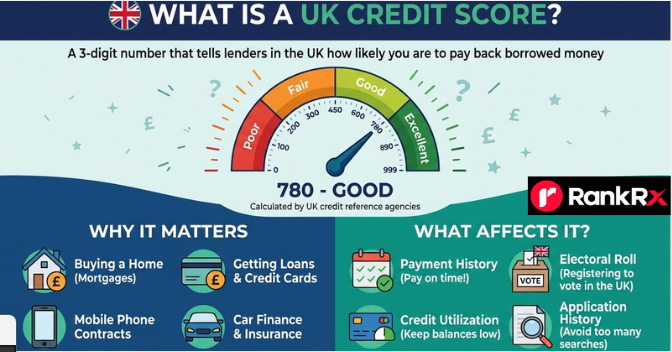
To satisfy your search intent immediately: A credit score in the UK is a number assigned to you by a credit reference agency, representing your creditworthiness based on your borrowing history. It tells lenders how risky it is to lend you money.
READ MORE: SD Bullion 5 Best SEO Truths on E-Commerce Trust
Unlike some countries where a single score is used, the UK has no single universal score. Instead, three main agencies—Experian, Equifax, and TransUnion—calculate your score using their own distinct algorithms and numerical scales.
| Credit Agency | Score Range | What a “Good” Score Looks Like |
|---|---|---|
| Experian | 0 to 999 | 881 to 960 (Very Good to Excellent) |
| Equifax | 0 to 1000 | 811 to 880 (Very Good) |
| TransUnion | 0 to 710 | 604 to 627 (Good to Excellent) |
1. The Algorithm of Trust: How Your Score is Calculated
Your credit score is a predictive algorithm. It is not a moral judgment; it is a statistical calculation of risk. Lenders use it to predict the likelihood of you defaulting on a loan within the next 12 to 36 months.
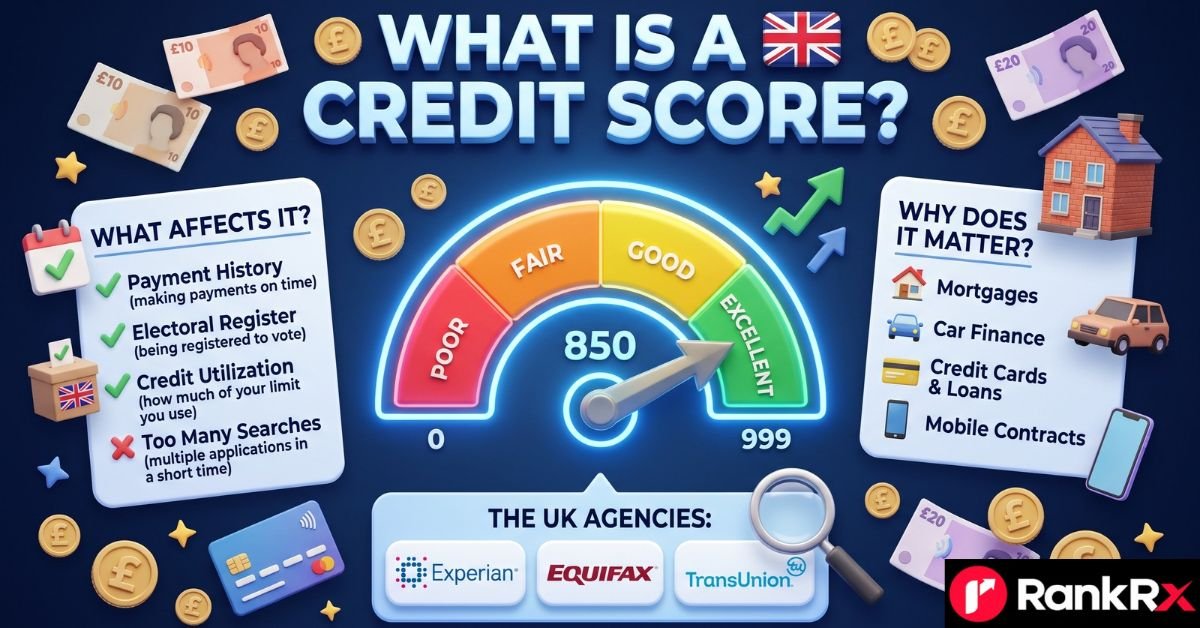
The algorithms primarily look at:
- Payment History: Have you paid your bills on time? (This is the biggest factor).
- Credit Utilisation: How much of your available credit limit are you using? (Using more than 30% is usually seen as a red flag).
- Length of History: The longer you have managed credit well, the better.
- Credit Mix: Can you handle different types of debt (credit cards, loans, mortgages)?
- Recent Applications: Too many hard searches in a short period signals desperation.
The SEO & Business Takeaway:
Google’s search algorithms work in exactly the same way. Your website has a “Digital Credit Score” (Domain Authority, Trust Flow, E-E-A-T). Google looks at your history (site age), your payment history (consistent publishing), and your credit utilization (spam vs. high-quality content).
Actionable Step: Audit your website’s E-E-A-T. Are you paying your digital “bills” on time by keeping your site secure (HTTPS) and free of broken links? Are you utilizing your authority well by publishing high-quality, original content?
2. The YMYL Factor: Why Financial Content is So Strictly Regulated
Because credit scores control access to housing, loans, and financial stability, they fall under Google’s YMYL (Your Money or Your Life) guidelines.
Google demands extremely high E-E-A-T (Experience, Expertise, Authoritativeness, Trustworthiness) from any website writing about credit scores. If you are a financial advisor or a fintech SaaS company, you cannot publish thin, poorly researched blog posts. The stakes are too high.
The SEO Takeaway:
If you are marketing a financial service, your content must be verified and expert-led. Google’s May 2026 Core Update continues to heavily penalize sites that publish unverified financial advice.
Actionable Step: Add a “Reviewed by a Financial Expert” badge to your blog posts. Link to primary sources like the UK’s Financial Conduct Authority (FCA) or MoneySavingExpert. Use FinancialProduct schema markup to help search engines categorize your content accurately.
3. Digital Identity and Cyber Hygiene
Your credit report contains some of the most sensitive data about you: your address history, your loans, and your financial associations.
If a cybercriminal steals your identity, they can take out loans in your name, destroying your credit score and your ability to secure a mortgage.
The SEO & Cybersecurity Takeaway:
Just as you must protect your physical and financial identity from fraud, healthcare and tech businesses must protect their digital identities from malicious actors. A data breach is the digital equivalent of identity theft.
Actionable Step: Check your own credit report regularly via services like ClearScore or MoneySavingExpert’s Credit Club to spot fraudulent activity. For your business, ensure you have strict Zero-Trust cybersecurity protocols in place to protect your clients’ sensitive data.
4. The Power of Long-Tail Search Intent in Finance
The query what is a credit score UK is a broad, top-of-funnel informational query. But it spawns thousands of high-intent long-tail searches that financial brands target: what is a credit score UK.
- How to check my credit score for free?
- Does checking my credit score affect it?
- How long does a default stay on my credit file?
- How to improve my credit score before a mortgage?
The SEO & Business Takeaway:
You cannot build a successful financial marketing strategy by only targeting the head term. You need to build a topical cluster of content that answers every possible question a user might have about their finances.
Actionable Step: Use tools like Google’s “People Also Ask” and AnswerThePublic. Create dedicated blog posts for each specific long-tail question. Internally link them all back to your main “Credit Score” pillar page. This builds massive topical authority. what is a credit score UK.
5. How SMEs Use Business Credit Scores
It is not just individuals who have credit scores. Small and Medium Enterprises (SMEs) have business credit scores. If you run a digital agency, a healthcare startup, or an e-commerce store, your business credit score dictates the interest rates you get on commercial loans, credit cards, and even lease agreements.
Unlike personal scores, business scores are tied to the company’s registration (Companies House) and its financial history. what is a credit score UK.
The SEO & Business Takeaway:
As your digital business grows, your corporate footprint must also grow. Google and financial institutions both look for transparency. what is a credit score UK.
Actionable Step: Ensure your business has a clean digital footprint. Register on Companies House, have a clear, transparent “About Us” and “Contact Us” page on your website, and ensure your NAP (Name, Address, Phone Number) is consistent across the web. what is a credit score UK.
Common Mistakes to Avoid
When managing your credit score (or your website’s digital authority), avoid these critical errors.
- Checking with only one agency: Experian, Equifax, and TransUnion hold different data. A mistake on one report might not show on the others. Check all three. what is a credit score UK.
- Maxing out credit cards: Keeping your credit utilization below 30% is crucial. Even if you pay it off every month, high utilization at the time of the check hurts your score.
- Closing old accounts: Closing an old credit card you rarely use can lower your available credit and shorten your credit history, damaging your score. what is a credit score UK.
- Not being on the electoral roll: If you are not registered to vote at your current address, lenders cannot verify your identity, and your score will plummet. what is a credit score UK.
- Ignoring errors: Mistakes on credit reports are common. If you spot an error, dispute it immediately with the agency.
FAQs
What is a good credit score in the UK?
It depends on the agency. For Experian, a score between 881 and 960 is considered Very Good. For Equifax, it is 811 to 880. For TransUnion, it is 604 to 627. what is a credit score UK.
Does checking my own credit score lower it?
Checking your own score is a “soft search” and is not visible to lenders. It has zero impact on your credit rating.
How often is my credit score updated?
Most credit reference agencies update their data roughly every 4 to 6 weeks, depending on when your lenders report information to them. what is a credit score UK.
How long does a missed payment stay on my credit file?
A missed payment stays on your credit report for six years from the date of the missed payment, even if you pay it off later. what is a credit score UK.
Can I get a mortgage with a bad credit score?
It is harder, but not impossible. Some specialist lenders offer mortgages to people with poor credit, but you will likely face higher interest rates and larger deposit requirements. what is a credit score UK.
Conclusion
Understanding what is a credit score UK is essential for navigating the modern financial landscape. It is an algorithmic measure of risk that dictates your access to property, capital, and opportunity.
For digital marketers, the parallels are impossible to ignore. Building a high credit score requires years of consistent, responsible behavior. Building a high-authority website requires the exact same discipline. By prioritizing trust, accuracy, and genuine expertise, you build a digital footprint that will survive any algorithmic update.
SEO is probabilistic, not a formula. Results vary by site, niche, and competition. But when you focus on building a foundation of trust, you give your finances—and your website—the best possible chance to succeed.
Disclaimer: This article is for informational and educational purposes only. It does not constitute financial or legal advice. Credit scoring models and lending criteria can change. Always consult a qualified financial advisor or check the official websites of Experian, Equifax, or TransUnion for the most current information. what is a credit score UK.