
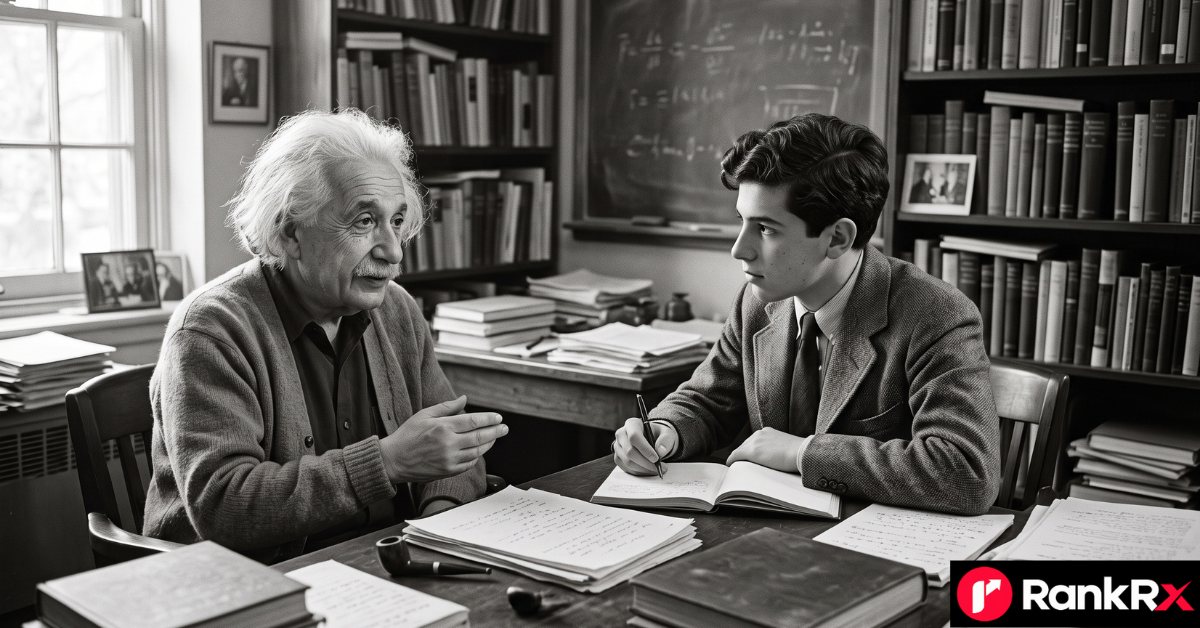

Type two famous names into Google and you get a quiet kind of promise: there must be a story here. With albert einstein and mort zuckerman, that instinct is half right.
Einstein, the physicist, died in April 1955. Mortimer “Mort” Zuckerman, the Canadian-American billionaire, was born on June 4, 1937, so he was a teenager when Einstein died. No meeting, friendship or shared project between them appears in anything I could verify.
Disclaimer: This article is for general information and editorial guidance. Biographical details and affiliations may change, and I couldn’t verify every historical claim. Results from any content strategy vary, so consult an experienced SEO or editorial professional for site-specific advice.
There is a real thread, though, and it runs through one Princeton institution. This guide lays out what can be confirmed, what can’t, and why searches like this one are a useful lesson for anyone who writes content for a living.
The Quick Answer
There is no documented personal relationship between the two men. The verifiable overlap is institutional:
- Einstein was a professor at the Institute for Advanced Study (IAS) in Princeton.
- Zuckerman is a former trustee of that same institute.
- Zuckerman has since funded neuroscience and science-leadership programmes, a field that Einstein’s name is often attached to in popular culture, even though Einstein himself never worked on it.
READ MORE: How to Get a Scholarship to Study in the UK (2026 Guide)
That’s the whole documented story. Everything else you may see online should be treated with suspicion until a reliable source backs it up.
Who They Are at a Glance

| Albert Einstein | Mort Zuckerman | |
|---|---|---|
| Known for | Theoretical physics, relativity | Real estate, publishing, philanthropy |
| Born / died | 1879 / 1955 | Born 1937 |
| Main field | Science | Business and media |
| Link to Princeton’s IAS | Professor, 1933 to 1955 | Former trustee |
| Overlap in lifetimes | Yes, about 18 years | Zuckerman was 18 when Einstein died |
The overlap row matters more than it looks. A lot of “connection” searches fall apart once you place two people on the same timeline.
Is There a Real Link Between Albert Einstein and Mort Zuckerman?
Short version: not a personal one, but yes, an institutional one. Here is what the sources support.
The Institute for Advanced Study
Albert Einstein was a professor at the IAS from 1933 to 1955. The institute’s own history says it invited him from Germany in 1933, and he lived in Princeton until his death. He lived on Mercer Street until 1955.
Zuckerman’s official biography lists him as a former trustee of the Institute for Advanced Studies at Princeton. I couldn’t find public dates for his trusteeship, so I won’t guess them. What the biography does support is that his name and Einstein’s both appear in the history of the same institution.
That’s a real but modest connection. Many people have been associated with the IAS over the decades. Sharing an institution isn’t the same as knowing each other, and no source suggests the two men ever met.
Science philanthropy and the “Einstein halo”
Zuckerman’s science giving is easy to verify. In 2012 he pledged $200 million to endow the Mortimer B. Zuckerman Mind Brain Behavior Institute at Columbia University, which studies the neural sciences and human behaviour. In 2016 he pledged $100 million to create the Zuckerman STEM Leadership Program, which supports graduate and postdoctoral scientists.
Einstein is often used as shorthand for “genius” in articles about science and the brain, so it’s easy to see why a writer or a reader might pair the names. That is an association in people’s minds, not a documented link between the two men.
What we can’t say
To keep this honest, here is what I could not find:
- Any record of Einstein and Zuckerman meeting or corresponding
- Any verified quote from one about the other
- Any joint project, donation or event involving both
If you see a claim like that elsewhere, ask for the primary source. A dated letter, archive record or reputable news report counts. A screenshot or an unsourced “famous quote” doesn’t.
Why Queries Like Albert Einstein and Mort Zuckerman Are Tricky
If you write for RankRX readers, this is the useful part. “Person A and Person B” queries look simple, but they’re a trap for lazy content.
The search intent is unclear
Nobody can tell from the query alone what the searcher wants. Based on how people search for name pairs, plausible intents include:
| Possible intent | What the reader wants | What a good page does |
|---|---|---|
| Connection check | “Did these two know each other?” | States clearly that no personal link is documented |
| Quote lookup | “Did one say something about the other?” | Explains that no verified quote was found |
| Institutional link | “Is there a shared organisation?” | Explains the IAS connection with sources |
| Brain and genius angle | “What about Einstein’s brain and brain research?” | Separates the Zuckerman Institute from Einstein |
| Random curiosity | “Why are these two names together?” | Gives a short, honest overview |
A page that answers the first question in its opening lines serves most of these visitors immediately.
The pull toward invention
When a keyword suggests a story, there’s a temptation to supply one. That might mean a fictional dinner conversation, a “what Einstein would have said” quote, or a vague claim that “the two shared a passion for science.” These are exactly the kinds of pages that tend to age badly, because they offer nothing a reader can verify and a good deal that a fact-checker can knock down.
For a brand like RankRX, whose credibility rests on practical, evidence-based advice, publishing invented connections would be damaging even if a page briefly ranked.
How to Research and Structure a Page Like This
Here is a repeatable process for any entity-pair keyword.
Step 1: Check the timeline first
Write down birth and death dates, major roles and locations. In this case, that alone shows the two men could have overlapped only in Zuckerman’s teenage years. albert einstein and mort zuckerman.
Step 2: Look for shared institutions, not shared stories
Universities, boards, awards and organisations are often where real links live. Here, that’s the IAS. Official biographies and institutional history pages are the best sources. albert einstein and mort zuckerman.
Step 3: Separate documented facts from popular association
Keep two buckets: “confirmed by a reliable source” and “commonly implied but unproven.” Label them clearly on the page. albert einstein and mort zuckerman.
Step 4: Answer fast, then go deeper
Put the direct answer in the first 50 words or so. Then add context, a table and sources. This helps human readers, and it also suits featured snippets and AI summaries, which tend to favour clear, well-supported answers. There are no guarantees either way, and it’s best not to write purely for a feature box.
Step 5: Show your sources
Link to institutional pages, reputable news coverage and archives. Naming where a fact comes from is a straightforward trust signal, and it lets readers check you. albert einstein and mort zuckerman.
A Simple Content Checklist
| Do | Avoid |
|---|---|
| State plainly when no link is documented | Implying a connection through wording tricks |
| Use dates and institutions as evidence | Making up conversations or “imagined” quotes |
| Add a short “what we couldn’t verify” section | Hiding uncertainty to sound authoritative |
| Link to primary or institutional sources | Citing other blogs that repeat the same claim |
| Update the page if new sources appear | Treating the page as finished forever |
Common Mistakes to Avoid
1. Fabricating a connection to match the keyword
This is the biggest risk. If your research finds no link, say so. A page that honestly says “no documented relationship” can be more useful than one that pads out a story. albert einstein and mort zuckerman.
2. Repeating unsourced quotes
Einstein is one of the most misquoted people online. Adding a “fitting” line to your page, attributed to him or anyone else, without a source is a quick way to lose reader trust. When in doubt, leave it out. albert einstein and mort zuckerman.
3. Stuffing the exact phrase
Writing “albert einstein and mort zuckerman” in every other sentence reads badly and doesn’t help readers. Use the phrase where it’s natural, then use the people’s names, pronouns and descriptive terms. albert einstein and mort zuckerman.
4. Ignoring the timeline
Many false “connections” collapse when you compare dates. Do this check before you write a word.
5. Burying the answer
Readers searching a name pair want to know quickly whether a link exists. Don’t make them scroll through biography first. albert einstein and mort zuckerman.
6. Treating biographical details as settled
Roles, titles and affiliations change. Zuckerman’s positions, for example, are described differently across older and newer profiles, so prefer recent, official biographies and note when information may be dated.
7. Drifting into opinion or politics
Both men are public figures, and Zuckerman in particular has a public record in media and political commentary. A neutral explainer about a possible link doesn’t need to pass judgement on anyone. Stick to the topic of the query.
What This Means for Your Own Content Strategy
You may never write about these two people. The pattern still applies anywhere you target a “name and name” query, a “brand and brand” comparison or any pairing with unclear intent: albert einstein and mort zuckerman.
- Start from what you can prove. albert einstein and mort zuckerman.
- Be explicit about what you couldn’t confirm. albert einstein and mort zuckerman.
- Use structure (tables, short sections) to make the answer scannable.
- Review and update when better sources appear. albert einstein and mort zuckerman.
Search engines have said repeatedly that they aim to reward helpful, reliable, people-first content, so accuracy and clarity are also a sensible long-term approach, though nobody can promise a specific ranking outcome.
Conclusion
Albert Einstein and Mort Zuckerman never overlapped in any documented way beyond one institution. Einstein was a professor at the Institute for Advanced Study until his death in 1955, and Zuckerman later served as a trustee there. Zuckerman’s later philanthropy in neuroscience and science leadership adds a thematic echo but no personal link.
READ MORE: Fully Funded Scholarships UK 2026 The Real Guide
For readers, that’s the honest answer. For writers and marketers, it’s a reminder that a keyword is a question, not a story outline. When the facts are modest, a clear, sourced, well-structured answer beats an invented narrative every time.
FAQs
Did Albert Einstein ever meet Mort Zuckerman?
No meeting is documented in any source I could find. Einstein died in 1955, when Zuckerman was about 18, and nothing public suggests they crossed paths.
What is the connection between Albert Einstein and Mort Zuckerman?
The documented connection is the Institute for Advanced Study in Princeton. Einstein was a professor there for more than two decades, and Zuckerman is a former trustee of the institute. Beyond that, the link is only a thematic one around science and philanthropy.
Did Mort Zuckerman fund Einstein-related research?
I found no evidence of that. His science giving that I could verify includes the Zuckerman Mind Brain Behavior Institute at Columbia University and the Zuckerman STEM Leadership Program, neither of which is described as Einstein-related. albert einstein and mort zuckerman.
Is there a quote from Einstein about Mort Zuckerman, or the reverse?
I couldn’t find a verified one. Be cautious of any quote linking the two, especially without a dated primary source.
Why do people search for albert einstein and mort zuckerman together?
It’s hard to say for certain. Likely reasons include curiosity about the Institute for Advanced Study, interest in famous names tied to science, or a quote, article or video that mentioned both. Search volume for niche pairings can also be driven by a single viral post.
How can I verify claims about historical figures online?
Look for primary sources such as archives, official institutional pages and dated news reports. Be wary of claims that appear only on quote sites or social media images, and check whether the timeline of the people involved even allows the story. albert einstein and mort zuckerman.
For more updates visit: rankrx.co.uk