

Medical residency programs face an overwhelming application volume. With top medical specialties receiving thousands of applications for a handful of positions, program directors are turning to modern software tools to handle the deluge. At the centre of this shift is ai residency application screening a technology designed to parse complex candidate data, accelerate holistic reviews, and help committees make fairer, more consistent decisions.
For healthcare operations managers, program coordinators, and digital strategists, understanding how ai residency application screening functions is essential. It represents more than a simple administrative shortcut; it is a fundamental shift in talent acquisition strategy within graduate medical education (GME).
This guide breaks down how AI screening systems work in practice, the real-world advantages and algorithmic risks, and how medical institutions can implement these tools responsibly while safeguarding candidate equity.
The Growth of AI Residency Application Screening in GME
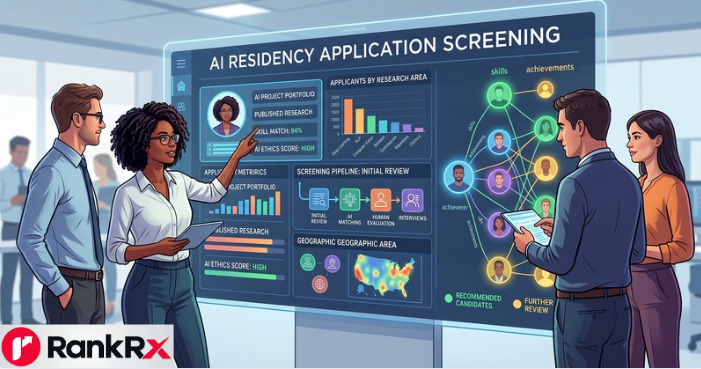
In conventional Graduate Medical Education recruitment, program directors relied on rigid metric filters such as USMLE Step 1 scores or class rank cut-offs simply to reduce application piles to a manageable size. However, as medical boards transitioned USMLE Step 1 to pass/fail, those old filtering shortcuts lost their utility, forcing programs to evaluate thousands of candidate files manually.
+-------------------------------------------------------------------------+
|                  THE MEDICAL RECRUITMENT BOTTLENECK                     |
+-------------------------------------------------------------------------+
|                                                                         |
|  [ Thousands of ERAS Files ]                                            |
|              |                                                          |
|              v                                                          |
|  [ Step 1 Pass/Fail Transition ] ---> [ Manual Bottleneck / Overwork ]  |
|              |                                                          |
|              v                                                          |
|  [ AI Application Screening ] ---> [ Streamlined Holistic Shortlist ]   |
|                                                                         |
+-------------------------------------------------------------------------+
Modern ai residency application screening tools solve this operational bottleneck by automating file parsing, extracting unstructured qualitative data (like personal statements and letters of recommendation), and scoring candidates based on customizable competency frameworks. Platforms like Thalamus Cortex, which integrate directly with the AAMC ERAS (Electronic Residency Application Service) Program Director’s WorkStation, demonstrate how algorithms can quickly index years of application history to surface candidates who closely match a program’s strategic objectives.
How AI Application Screening Works Behind the Scenes
Unlike simple database filters that discard files based on a single numerical threshold, natural language processing (NLP) and machine learning (ML) models analyze candidates across multi-dimensional criteria.
When evaluating ai residency application screening software, most platforms execute a three-stage workflow:
1. Data Ingestion & Unstructured Text Extraction
The system ingests ERAS application files, transcripts, medical school performance evaluations (MSPEs), and letters of recommendation (LORs). NLP engines scan these documents to pull context, sentiment, and key indicators such as leadership roles, research citations, community service hours, or specialized clinical exposure.
2. Algorithmic Scoring & Competency Matching
Rather than relying on generic global criteria, effective ai residency application screening allows program leadership to weight specific attributes. For example, a rural family medicine program can prioritize applicants with documented regional commitment, while an academic surgery program can prioritize grant experience and clinical honors. The machine learning model generates an alignment score for each candidate.
3. Blinded & Anti-Bias Filtering
To encourage objective review, AI platforms can automatically redact non-predictive demographic markers, candidate names, or institutional logos. This “blinded review” capability helps reviewers evaluate qualifications without falling victim to unconscious affinity bias.
Comparing AI Screening vs. Traditional Selection Methods
To understand why healthcare recruitment is evolving, it helps to compare traditional manual screening against automated AI workflows:
| Feature / Factor | Traditional Manual Screening | Simple Keyword Filtering | AI Residency Application Screening |
| Review Velocity | Slow (15–30 mins per file) | Instant, but rigid | Fast (Reduces review time up to 50%) |
| Qualitative Evaluation | High depth, but human fatigue causes inconsistency | Ignores qualitative context | Analyzes text via Natural Language Processing |
| Bias Vulnerability | Subject to personal or institutional bias | High risk of arbitrary candidate exclusion | Configurable for blinded scoring & equity audits |
| Holistic Assessment | Hard to maintain across 5,000+ files | Non-existent | High consistency across entire pool |
Strategic Benefits for Medical Programs
Implementing ai residency application screening provides clear strategic advantages for Graduate Medical Education programs:
- Massive Time Savings: Program directors and faculty reviewers frequently spend hundreds of hours reviewing files during peak recruitment season. AI triage cuts administrative overhead by organizing candidates into stratified review tiers.
- Uncovering Overlooked Talent: Traditional threshold filters often disqualify candidates who lack top-tier test scores but possess extraordinary clinical skill, research output, or unique personal backgrounds. ML models identify these “hidden gem” applicants who would otherwise be screened out by rigid cut-offs.
- Standardized Competency Scoring: Every faculty member evaluates candidates through a slightly different lens. AI establishes a consistent baseline score aligned with the institution’s core requirements.
- Mitigating Gender & Socioeconomic Bias: Studies show that letters of recommendation frequently contain gendered language or subtle biases. NLP tools can flag or standardize these linguistic nuances during initial screening phases.
Critical Risks and Algorithmic Vulnerabilities
While the operational efficiency is compelling, reliance on automated tools introduces distinct risks that program leaders must actively manage.
┌─────────────────────────────────────────────────────────────────┐
│                    ALGORITHMIC BIAS PIPELINE                    │
├─────────────────────────────────────────────────────────────────┤
│                                                                 │
│   [ Historical Match Data ]                                     │
│              │                                                  │
│              ▼                                                  │
│   ┌────────────────────┐     Unquestioned     ┌──────────────┐  │
│   │  Biased AI Model   │ ───────────────────► │ Excluded     │  │
│   └────────────────────┘      Training        │ Diversity    │  │
│              │                                └──────────────┘  │
│              ▼                                                  │
│   ┌─────────────────────────────────────────────────────┐       │
│   │    Systemic Replication of Past Hiring Habits       │       │
│   └─────────────────────────────────────────────────────┘       │
│                                                                 │
└─────────────────────────────────────────────────────────────────┘
1. Training Set Bias
Machine learning models learn from historical data. If a residency program’s past five years of match data reflect systemic hiring biases, an uncalibrated AI model will simply automate and amplify those historical biases under the guise of objective scoring.
2. Transparency & The “Black Box” Problem
When an algorithm recommends inviting candidate A over candidate B, committee members need to understand why. Complex neural networks that cannot explain their scoring criteria create compliance and governance risks for academic health institutions.
3. Candidate Over-Optimization
As applicants become aware that 5 Best Practices for AI Residency Application Screening utilize ai residency application screening, many turn to generative AI tools to draft personal statements or tailor resume keywords specifically to pass algorithmic filters. This creates an escalation where AI applications are screened by AI tools, making human oversight indispensable.
Common Mistakes to Avoid in AI Application Screening
Medical recruitment teams often make key errors when adopting automated screening software. Avoid these pitfalls to ensure fair and accurate selection:
- Treating AI Outputs as Final Decisions: AI screening should serve strictly as a decision-support tool, never an automated decision-maker. Human faculty must always make final interview and ranking choices.
- Failing to Audit Custom Model Weights: Leaving default algorithmic weights unchanged without aligning them to your program’s unique mission leads to misaligned candidate shortlists.
- Ignoring Historical Data Cleanliness: Feeding historical candidate records into an AI model without first stripping out past bias leads to repetitive hiring patterns.
- Skipping Vendor Compliance Reviews: Failing to ensure your AI vendor complies with data privacy regulations (such as HIPAA and FERPA) exposes candidate data to security vulnerabilities.
Best Practices for Implementing AI Screening Responsibly
To maintain E-E-A-T standards, protect candidate equity, and optimize recruitment efficiency, follow this operational checklist:
- Maintain Human-in-the-Loop Oversight: Establish a strict policy where all AI-generated shortlists are reviewed by a human admissions committee prior to issuing interview invites.
- Conduct Regular Bias Audits: Regularly evaluate your screening results across demographic groups to verify that the software does not disproportionately exclude underrepresented groups in medicine (URiM).
- Use Blinded Review Protocols: Activate data-blinding features to remove non-job-related personal details during preliminary scoring rounds.
- Set Transparent Criteria: Document the exact competency weightings used by your ai residency application screening software so all committee reviewers share a clear understanding of the scoring logic.
FAQs
What is AI residency application screening?
It refers to software platforms utilizing artificial intelligence, natural language processing, and machine learning to analyze, score, and rank medical residency applications. It helps program directors conduct holistic reviews efficiently amidst rising application volumes.
Does ERAS use AI to screen residency applicants?
ERAS partners with GME software platforms like Thalamus to provide programs with advanced application management tools. Individual residency programs decide how to configure and utilize AI screening features within their specific review workflows.
Can AI eliminate bias in medical residency recruitment?
AI can reduce human fatigue and affinity bias when configured for blinded reviews. However, if trained on biased historical data, AI can replicate past disparities. Ongoing human auditing is necessary to maintain fairness.
How does AI process qualitative data like letters of recommendation?
Using Natural Language Processing (NLP), AI tools analyze text for key competency terms, clinical performance markers, and contextual sentiment, translating narrative documents into structured scoring metrics.
Will AI replace human program directors in candidate selection?
No. Industry guidelines and medical education accreditation bodies emphasize that AI must function strictly as an auxiliary tool to assist human decision-making, not replace human judgment.
For more updates visit: rankrx.co.uk